Most CFOs Are One Regulation Away From a Carbon Problem They Didn't Plan For
Most companies have climate targets but few have aligned capital plans. Why CFOs must treat carbon as a financial variable before it hits margins.

Get instant access
Link
Every CFO knows how a budget cycle works. You set assumptions, model scenarios, allocate capital, track actuals, and adjust when reality moves differently than expected.
Carbon planning is not fundamentally different from that.
The logic is familiar. But most companies still do not manage it through the same planning structures they use for finance, and that is usually where decarbonization strategies begin losing traction.
What the CFO Actually Sees
Even when sustainability teams are doing strong work, the CFO often only sees the final outputs: a GHG inventory, an SBTi target, a transition plan, and a list of initiatives.
What tends to remain invisible is the financial and operational layer underneath it all. How much capital each initiative needs over time. What the cost per tonne reduced looks like. Whether the reduction pathway still holds under different business scenarios. How all of this connects to investment planning and profitability assumptions.
The information may technically exist, but it often sits in separate systems, runs on different timelines, and belongs to different teams. As a result, sustainability work ends up feeling disconnected from actual decision-making, even when the work itself is solid.
The Timing Problem Companies Underestimate
A lot of companies still think of 2030 as distant enough to delay difficult decisions. On paper, it can sound manageable. In practice, once you map out what operational changes actually require, the timeline compresses very quickly.
Supplier transitions take years. Facility upgrades take years. Fleet replacement cycles take years. By the time urgency becomes obvious internally, some of the lower-cost and lower-risk options are already off the table.
The practical decision window is usually much shorter than the headline target suggests.
Why Green Investments Often Lose Budget Discussions
The way decarbonization costs are framed creates another issue. If investments are evaluated purely as upfront expenditure, most initiatives look unattractive in the short term. Projects get delayed, reduced, or pushed into future budget cycles because the immediate financial case appears weak.
But that framing ignores the cost of waiting.
"The shift we're seeing is finance leaders treating sustainability spend like any other capital decision. A good example is with green electricity. A REC is an operating expense that recurs every year with nothing to show for it. A solar installation is a depreciating asset that starts paying back within a few years and generates measurable savings for decades." Katie Sidell-Schneider, Head of Customer Success at Cozero
As EU ETS free allocations phase out progressively from 2026 to zero by 2034, companies with significant Scope 1 exposure will face rising carbon costs that compound each year. For energy-intensive manufacturers, this trajectory is material enough to affect operating margins well before 2034.
At that point, the impact does not remain inside a sustainability report. It starts showing up directly in operating margins and earnings pressure.
Decarbonization Is Not a One-Time Project
Even when companies approve decarbonization investments, another problem appears after deployment.
A common mistake is treating decarbonization as something companies can complete once and move on from.
Install technology. Close the initiative. Mark it as done.
In reality, most outcomes depend on operational factors that continue long after deployment. Commissioning delays happen. Internal adoption moves unevenly. Expected reductions do not always materialize exactly as modeled.
Without continuous monitoring and adjustment, finance teams often conclude that the investment itself failed, when in practice the issue was the lack of an ongoing management process around it.
What Changes When Carbon Planning Becomes Financial Planning
Once carbon planning is treated more like financial planning, the conversation changes quickly.
The focus shifts toward questions finance teams already ask every day. How much capital is required to stay on the transition path the company has committed to? Which initiatives deliver the highest emissions reduction per euro invested? How do future carbon costs affect profitability assumptions? Which assets risk becoming economically obsolete earlier than expected?
The analytical tools for answering these questions already exist. MACC curves, ROCI models, carbon-adjusted EBITDA scenarios, and TCO frameworks that incorporate emissions exposure alongside maintenance and energy costs are available and increasingly used by leading organizations. Most companies, however, have yet to integrate them into standard planning cycles. The good news is that this rarely requires entirely new systems. It mostly requires better integration between information that already exists and planning processes that already run every quarter.
The Gap Is Still Large
CDP’s 2025 report From Plans to Capital, which analyzed disclosures from nearly 12,000 companies, found that while most companies reported having emissions reduction initiatives in place, only 11% disclosed capital expenditure aligned with those transition plans.
That gap matters because it suggests the problem is no longer awareness. Companies are already thinking about decarbonization. The issue is that the thinking often does not translate into structured capital allocation decisions.
CDP also found that companies disclosing low-carbon initiatives reported over US$54 billion in annual savings in 2024, suggesting that acting on decarbonization plans delivers measurable financial value.
Where This Usually Starts
In most organizations, the issue is not a lack of sustainability work. The issue is that the work sits adjacent to financial planning instead of inside it.
That is why the starting point is usually not another reporting layer or another standalone sustainability process. It is connecting emissions planning to the same budgeting, investment, and operational review structures the finance organization already trusts.
At a certain point, carbon stops looking like a separate sustainability metric and starts behaving more like a financial variable that companies are only beginning to price in properly.
Sources
CDP. (2025, November 11). From Plans to Capital: Unlocking Credible Transition Finance at Scale. https://www.cdp.net/en/press-releases/companies-save-54bn-through-low-carbon-action
Clean Energy Wire. (2026, February 4). EU Commission to propose free emissions allowances for industry beyond current cut-off period. https://www.cleanenergywire.org/news/eu-commission-propose-free-emissions-allowances-industry-beyond-current-cut-period-media-report
CBAM Guide. (2026, April 4). EU ETS free allocation phase-out: CBAM factor by year 2026–2034. https://cbamguide.com/carbon/free-allocation/
International Carbon Action Partnership. (2024). EU Emissions Trading System (EU ETS). https://icapcarbonaction.com/en/ets/eu-emissions-trading-system-eu-ets
McKinsey & Company. (n.d.). Automating marginal abatement cost curve generation. https://www.mckinsey.com/capabilities/sustainability/how-we-help-clients/catalyst-zero/automating-macc-generation

Related articles
Connecting Carbon Emissions and Financial Statements using IFRS Accounting Standards
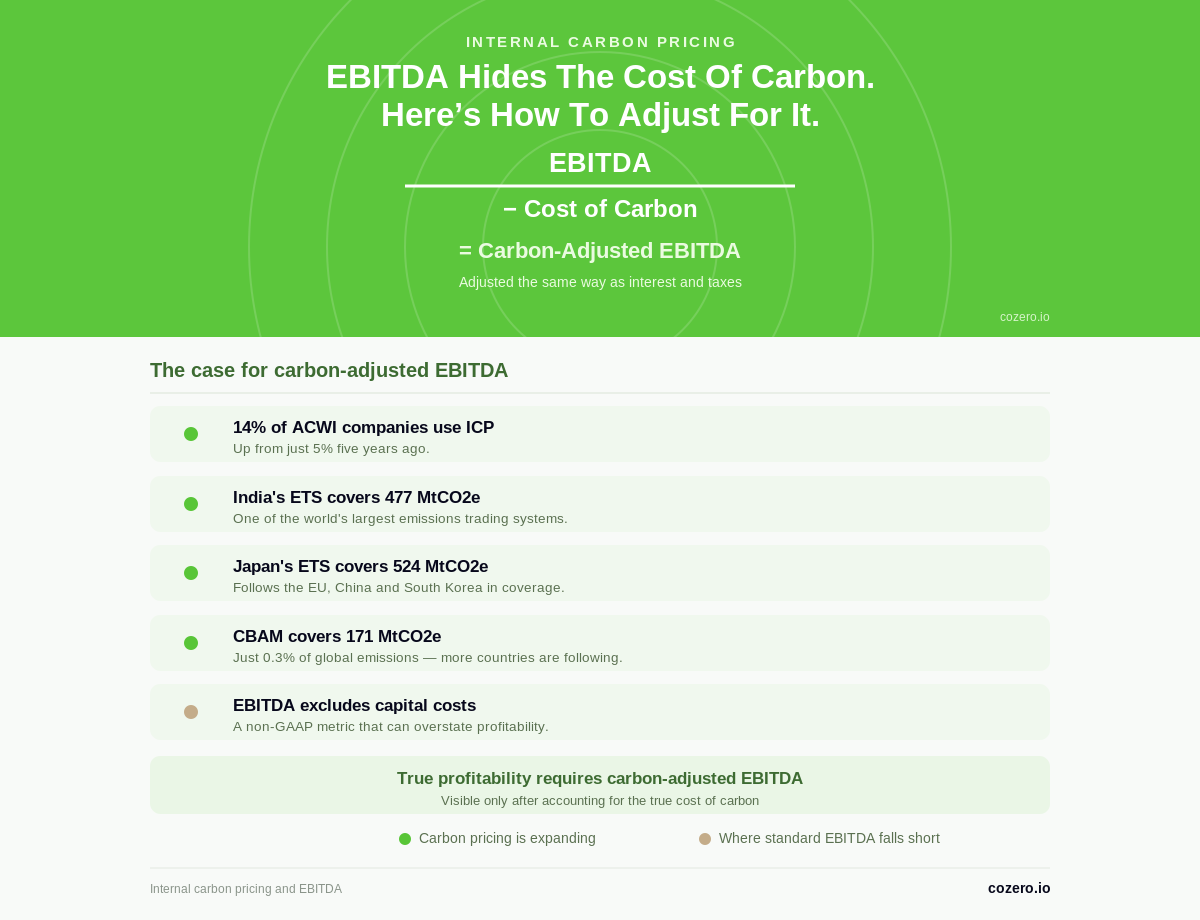
Internal Carbon Pricing: A Practical Path to Carbon-Adjusted EBITDA