How Germany's Industrial Sector has Responded to the EU's ETS Review
German industrial associations weigh in on the EU's ETS update, sharing what matters most for competitiveness and decarbonisation in manufacturing.

Get instant access
Link
This month (July 2026), The European Commission plans to release its EU Emissions Trading System (ETS) review package for ETS 1, which will provide a much-anticipated update. The Commission ended its public consultation on the post-2030 ETS implementation on 4 May.
The planned updates have sparked debates about the role of the ETS in relation to industrial competitiveness, specifically in Germany. Advocates have highlighted its positive role in the economy: in 2025, it generated around €43 billion in revenue.
The EU ETS 1 records emissions across 10,000 plants in the key sectors: energy, domestic aviation and industry. It covers 36% of the EU's GHG emissions, operating on a cap-and-trade basis to create market incentives to invest in low-carbon emissions technologies.
Companies operating in eligible sectors trade certificates of carbon emissions reduction in a marketplace that results in a market-based price on carbon emissions. ETS auctions have raised over €258 billion cumulatively since inception in 2005.
Issues that will be determined within the upcoming review include:
- The trajectory of benchmark values for cap reductions after 2030
- Whether the scope of ETS will expand to include carbon removals
- Market stability reserve design
- A reduction to free allocation certificates for aviation
Cozero works with industrial manufacturers who use our carbon management suite to manage their emissions planning, measurement and reduction. Learn about our work to help manufacturers in Germany drive emissions reductions.
Perspectives from German Industry
The ETS review package is expected to address heavily debated mechanisms within the ETS that have impacts on Germany's industrial sector. In total, manufacturing industries produce around a quarter of the nation’s emissions, though not all activities are covered by the ETS.
Maintaining competitiveness is a key concern for German industrial associations overall. Germany is a world leader in many industrial sectors, including vehicle manufacturing, chemicals and pharmaceuticals. While manufacturing only accounts for 7.6% of all companies in Germany, it provides 17.7% of jobs and 57.9% of Germany's GDP.
Deindustrialisation remains a concern for German industry, which lost around 240,000 industrial jobs in 2024 and 2025. Competitiveness, ongoing pressure from high prices and supply insecurity remain pressing concerns for German industry, and these issues show up in German trade associations’ views on the ETS.
The German DIHK (Chamber of Commerce and Industry), points to the need for improvements from a principles based approach, centering international, innovative, and cost-efficient approaches. The DIHK supports the ETS scope expansion to include carbon removals, a gradual pace of reduction to free allocation certificates, and including international certificates. It argues these approaches would deliver the intended steering effect without threatening competitiveness.
BDI (Federation of German Industries) calls for free allocation to continue until sufficient transformation conditions are in place, pointing to structural challenges. Without access to competitively priced renewable energy, renewable fuels including green hydrogen, and CO2 and other infrastructure, many companies want to decarbonise but structurally cannot. This creates unnecessary burdens for companies, rather than fulfilling the ETS's intended purpose of creating incentives to invest in low-carbon emissions processes and products.
The German government supports the prioritisation of industrial transition within the ETS review, in addition to slowing, but not reversing, emissions cuts and the phase out of free allowances. Policymakers in Berlin support its purpose as a driver of clean-energy investment, not a short-term lever for electricity rate reductions. The government also shared views on added safety nets during energy price shocks, such as using the Market Stability Reserve and allowing imported carbon credits.
Differences of opinion within the industrial sector
While different groups within German industry consider competitiveness challenges linked to structural issues, choosing which structural issues to focus on is still open to debate. The ETS revision package cannot alone solve those issues, but it does highlight agreement that ETS should not be weakened, but structured with competitiveness in mind.
More than 100 major European companies, including EDF, Volvo Group, Heidelberg Materials and Tata Steel, issued a transparent open letter that also reiterates the importance of viewing competitiveness challenges as structural issues, such as fossil-fuel-driven energy prices, overcapacity, market fragmentation, not climate policy, and calling for targeted improvements rather than weakening the ETS.
In spite of deindustrialisation concerns, some economists have argued that Germany’s industrial output remains relatively high, and an increase in specialised manufacturing could offset declines in some sectors. The BDI issued a report in 2024 concluding that, while Germany is “losing ground structurally as an industry location,” the way forward is to prioritise low-carbon industries.
Debates within Germany's industrial sector show that individual sectors do not necessarily form a single position on climate-related regulations. The ETS essentially creates some competition within sectors to decarbonise.
EU-wide survey of manufacturers
Emissions from ETS-covered electricity and industry have roughly halved compared to 2005 levels. An EIB survey of EU-based industrial manufacturers suggests that 80% of manufacturing firms now have a decarbonisation strategy.
Only 15% of firms report their largest emissions cuts have already happened, while 64% expect the biggest reductions within the next decade, meaning the most intensive phase of industrial decarbonisation is still ahead.
About 40% of firms are net buyers of allowances, meaning the ETS has genuinely constrained their decisions, while others have benefitted from free allocation, which is planned to phase out over time. In the survey, 94% of firms say relocating production abroad due to climate regulation is not part of their strategy now or in five years.
Manufacturers suggested that uncertainty about future energy and carbon prices and regulation constrained their investment decisions: not the carbon price itself.
EU's broader climate-focused work program
The ETS forms part of a broader work programme that touches on more policy issues linked to energy prices and long-term decarbonisation planning.
The European Commission presented its 2026 work programme on 21 October 2025. It is a key milestone in the 2024–2029 legislative cycle, outlining the legislative initiatives shaping EU climate and energy policy through 2040, in line with the Clean Industrial Deal agenda.
Here are the key issues in the work programme related to decarbonisation:
CBAM: Negotiations for a CBAM scope extension to cover downstream steel and aluminium goods are underway.
Electrification Action Plan: The EU Commission held public consultations on a comprehensive plan to support electrification in 2025. The focus is on decarbonisation in the transport sector, industry and buildings with an aim to remove barriers to faster uptake of electric technologies.
Review of EU ETS 1 Benchmarks: As described in the article, this review will address various aspects of the ETS, including the cap reductions after 2030.
Energy Union Package for the Decade Ahead: A package expected to include legislative proposals on the Energy Union Governance, Renewable Energy Directive, Energy Efficiency Directive and the CO2 transportation infrastructure and market.
ETS 2: The EU is also planning to make its ETS 2 fully operational by 2028 for additional sectors compared to ETS 1. It aims to cover fuel combustion in buildings, road transport and additional smaller industrial sectors.
Cozero's specialised support for industrial manufacturing businesses enables companies to access the competitive advantages of decarbonisation faster and with stronger financial control.
Speak to our experts to learn more.

Related articles
Connecting Carbon Emissions and Financial Statements using IFRS Accounting Standards
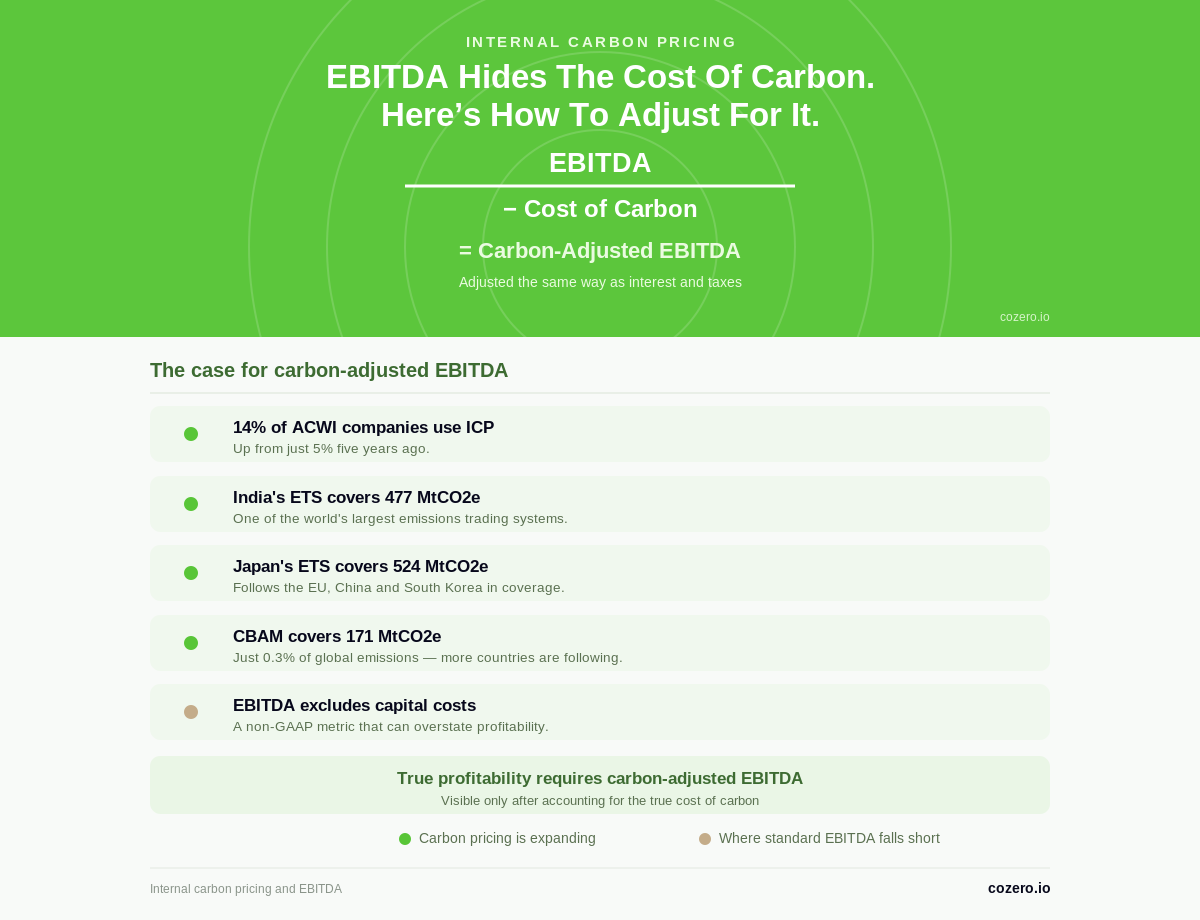
Internal Carbon Pricing: A Practical Path to Carbon-Adjusted EBITDA