42% of SBTi's Standard V2.0 is completely new. Here's how the changes affect future and current target setters
The SBTi's Corporate Net-Zero Standard v2.0 rewrites 42% of its content and revises 58% more. Here's what's new for target setters.

Get instant access
Link
What makes the V2.0 standard different
The standard makes significant changes to how companies can implement their targets. There are options for Scope 1, 2 and 3. Targets are now differentiated by company size, sector and country income level, and SMEs have lower requirements.
Notably, companies can now also use market instruments carbon credits to offset emissions and earn recognition for this. Substituting viable emissions reduction with market instruments, however, does not apply. The new approach supports procurement in identifying and choosing eligible products.
The approach to Scope 3 emissions reductions has changed, shifting to mandatory targets for any Scope 3 category that passes a 5% threshold of the total Scope 3 emissions, but this is optional for SMEs.
Something that may surprise people is that large corporations will be required to purchase carbon removals after 2035, and they can voluntarily report them in 2027.
Overall, more emphasis is now placed on aligning decarbonisation and corporate strategies.
"The Standard will help companies open their door to the benefits of decarbonization: embedding climate action into core business strategy, managing their transition risks, and strengthening long-term competitiveness in a rapidly changing global economy," said Francesco Starace, SBTi Chair of the Board of Trustees.
For more details, see the full draft of SBTi Standard V2.0.
V2.0 is part of a new strategic focus for SBTi
SBTi's 2026-2030 strategy has made a shift that recognises a critical shift from target setting to implementation. With transition risks related to cost, demand shifts and regulatory uncertainties, SBTi hopes to support corporations better. The shift in focus places a stronger emphasis on embedding the transition plan and decarbonization strategy into the core business strategy.
"The companies that lead in this next phase will help drive system-level solutions – turning climate action from a commitment into a source of long-term competitiveness and growth. SBTi will be an active member of the ecosystem," said Ani Dasgupta, President & CEO, World Resources Institute
Cozero's ecosystem directly aligns with this strategic shift
Cozero's platform supports companies who need to track and monitor emissions as well as implement SBTi targets. Cozero has a robust climate transition plan management approach that directly integrates into users' core business strategy. This approach is directly compatible with the new approach SBTi has chosen to take.
In our Act module, we directly align financial and emissions metrics and provide forward-looking planning tools. This way, companies can compare how their different strategic approaches impact their bottom line according to specific scenario pathways.
We continuously work to align our platform to the latest updates from voluntary and regulatory standards so our customers can focus on their most important work.
Timeline and validity for V2.0
Companies will be able to set targets under this new version on February 1, 2027. Companies can still submit targets under Standard V1.3.1 until December 31, 2027. In 2028, all new target submissions need to align with V2.0.
For the 11,000 companies who have already set or had their targets approved under version 1.0, their targets will remain valid until the end of their timeframe. SBTi recommends that companies with target commitments or renewals due in 2026 or 2027 move into version 2.0 in their next cycle. Companies may use SBTi's transition guidance to move to the updated standard.
Development timeline at a glance:
- 2026 - Public commenting period available for target setting tool and the new pathways and methods embedded in it.
- 2026 - SBTi plans to release a renewal policy to incorporate version 2.0 elements for companies who already set targets.
- 2027 - Version 2.0 will become effective on February 1.
- 2027 - December 31 is the last date to enter targets under V1.3.1.
- 2028 - V2.0 applies to all newly set targets.
New innovations of the SBTi Standard V2.0
A wide range of new innovations are incorporated into the SBTi Standard V2.0. The main themes relate to changes that emphasise how not whether a company implements targets.
Category A and B classification
Companies are classified into two groups, Category A (large companies) and Category B (SMEs) using various criteria to determine if they are a small, medium or large firm. Additional income group criteria for their country location applies to place them in a Category. The current thresholds for small, medium and large firms include the following:
- Net annual turnover: < €50M, €50–450M, ≥ €450M.
- Employees (FTE): <250, 250-999, >/= 1000.
- Income Group: Higher income country, Lower income country.
A medium company in a high-income country is also Category A if certain emissions levels or size variables apply. Companies with existing targets that meet Category B criteria will also be eligible for SME status.
Key differences between Categories A and B:
- A: Selection of optional target routes and transition plan due at target validation with 15 months' flexibility. In 2028, companies must report their Scope 1, 2 and 3 near-term targets, with limited assurance for the base-year inventory.
- B: The same target route options apply, but a transition plan is not required. As of 2028, companies must report their Scope 1 and 2 near-term targets. Assurance for scope 3 targets and base-year are recommended and not required.
Note: Baselines move to the most recent year's data, but companies can continue communicating progress against prior baseline years.
Implementation hierarchy
Companies can claim reduction approaches other than direct emissions cuts based on structural barriers. Preferences are not a viable way to claim those alternatives.
- Direct emissions reduction (for company, energy source and value chain).
- Market instruments for shared responsibility, must be reported separately from inventory claims.
- Sector level action, if structurally constrained.
- Alternative approaches need to meet quality criteria: additionality, unique attribution, temporal alignment and no double counting.
In addition, a "best-efforts" approach to target-setting that accounts for sector, geography, and legacy capital stock. Companies that face implementation barriers, including those with V1.0 targets, will not be removed from the system if they show efforts to reduce emissions.
Differentiation of pathways
New pathways embedded in a tool to support target setting. The standard includes sector, size, and country income-level targets and categories.
Existing guidance for aviation, shipping, cement, steel, chemicals, buildings, and forest, land and agriculture sectors remains valid until the end of January 2028. The existing pathways for those sectors have been incorporated into V2.0.
Changes to governance approach
V2.0 includes mandatory governance, board accountability, transition planning and disclosure.
- Direct board oversight: The board formally oversees SBTi targets.
- Transition plan requirement: Category A companies need to describe actions, timeframes, assumptions and dependencies in a transition plan, due at target validation with up to 15 months' flexibility.
- Corporate strategy integration: The transition plan must integrate into the core strategy.
- Assurance: Limited assurance is required for Cat A companies.
- Internal Approval: Requirement for internal approval of the standard, not public announcements.
Ongoing Emissions Responsibility (OER)
Voluntary tiers of engagement include Engaged (1%), Advanced (10%) and Leadership (100%).
Participating companies are assigned to tiers based on responsibility using market instruments to account for any covered emissions they haven't reduced annually. After 2035, they become mandatory.
There is also a requirement for larger companies to purchase eligible carbon removals starting in 2035, equivalent to 1% of ongoing Scope 1, 2 and 3 emissions.
Companies already in the SBTi system will also have access to this new framework.
New target setting options
In V2.0, Scope 1 and 2 targets are now reported separately.
Scope 1: Must cover 100% of direct emissions. Companies choose one or more of three possible target setting routes:
- A: Absolute reduction for the long-term target (optional).
- B: Sector pathway – Option for sector intensity reduction targets following a published pathway (required if C is not selected, no 15 months' grace period) or
- C: Asset transition – Targets based on asset transitions (required if B is not selected, no 15 months' grace period).
Scope 2: Must cover 100% of your purchased electricity, heat, steam and cooling. Companies choose between options:
- A: Scope 2 targets based on emissions reduction.
- B: Scope 2 targets based on increase in share of low-carbon electricity (LCE), contracting or matching. LCE now includes renewables, nuclear, and CCS-fitted generation.
- Procurement teams have actionable guidance and prioritization.
- Increased focus on the use of market instruments such as energy certificates, industrial and agricultural commodities and carbon credits in target implementation, all of which are subject to SBTi criteria for eligibility.
Scope 3: A single category must account for more than 5% of your total categories 1 to 14, with some applicable exclusions. Target setting is optional for Cat B SMEs.
GHG Protocol Interoperability
Some of the updates within SBTi's Standard V2.0 address issues undergoing revision by the Greenhouse Gas Protocol. The organizations commit to providing clear guidance and interoperability around these issues to support alignment for GHG emissions reporting.
- Scope 2 hourly matching: SBTi Standard V2.0 strengthens transparency around hourly matching and recognizes early adopters of this approach. The GHG Protocol is currently reviewing comments from public consultation on this Scope 2 reporting method.
- Market Instruments: Both organizations aim to support interoperability between GHG Protocol perspective and the credible use of actions and market instruments. SBTi's revisions in V2.0 through its implementation hierarchy enable greater flexibility around the use of market instruments toward target implementation. GHG Protocol is working on a multi-statement GHG reporting structure separating GHG inventory (physical inventory) from additional statements for project-based interventions and market instruments in its revision process.
"As the SBTi publishes its flagship Corporate Net Zero Standard Version 2.0, the SBTi and GHG Protocol reinforce our commitment to collaboration and interoperability, building on our years of working together, including as part of each other's committees and working groups." Tim Mohin, CEO, Greenhouse Gas Protocol
Cozero helps customers drive action towards Net Zero targets
SBTi's V2.0 update makes one thing clear: it's time to move from target setting to action. Cozero is designed to help companies build a robust climate transition plan keyed to their long-term targets.
Our approach integrates into your general ledger to help business leaders and boards view climate transitions as a core part of financial decision-making in a highly traceable control environment.
The software is built with a strategic focus on leveraging carbon emissions as a core business insight. This helps companies build stronger strategies and prevent transition risks.
Get started with a demo today.

Related articles
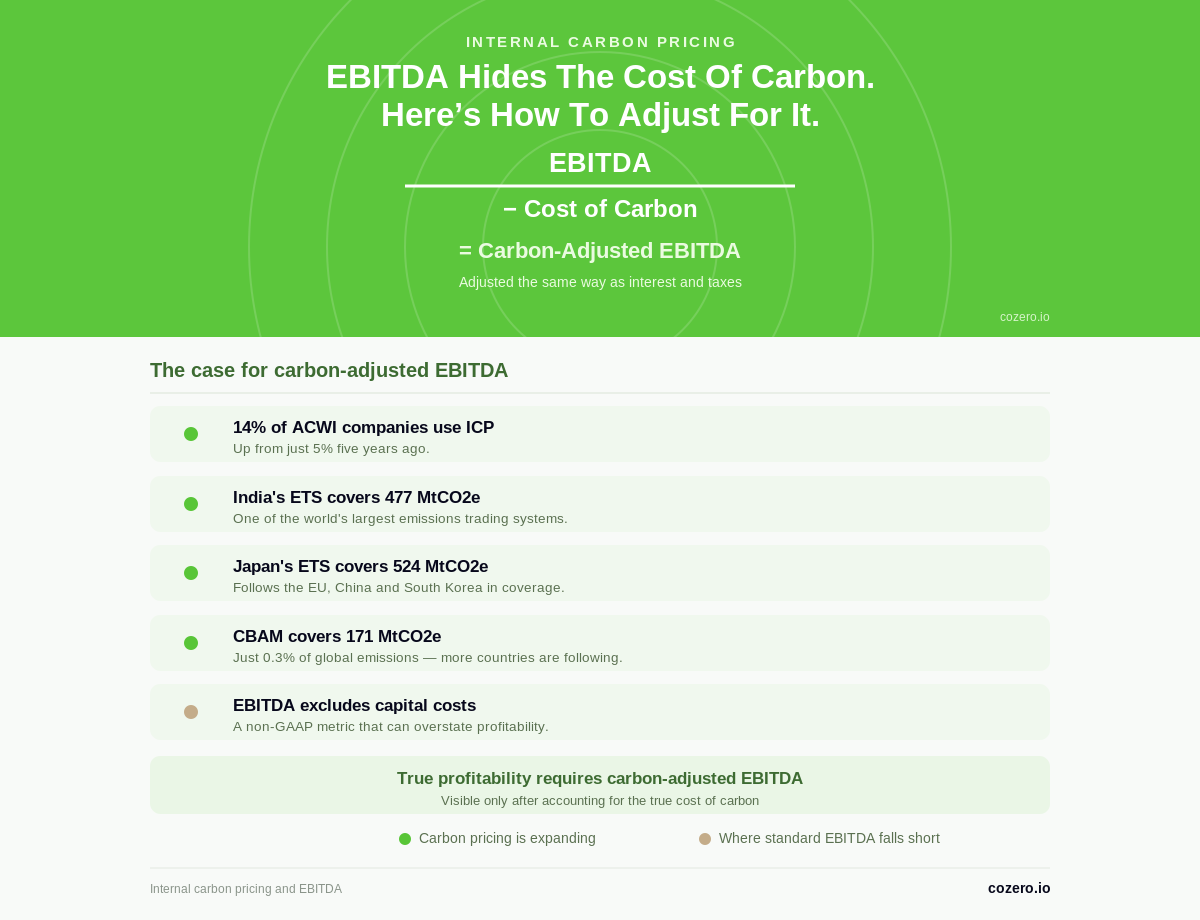
Internal Carbon Pricing: A Practical Path to Carbon-Adjusted EBITDA