Key similarities and differences between the ISSB and CSRD sustainability reporting standards
ISSB standards are spreading fast across jurisdictions. Key similarities and differences with CSRD to consider when preparing disclosures.

Get instant access
Link
ISSB Sustainability Standards are Spreading Globally: What does this mean for the EU's CSRD? ISSB standards are quickly becoming the de facto baseline of global reporting outside Europe. Multi-national enterprises operating in Europe need to understand how the two sets of standards relate to each other.
ISSB and CSRD are the two main mandatory sets of standards emerging as the most influential reporting approaches globally:
- The EU's European Sustainability Reporting Standards (ESRS) required by the Corporate Sustainability Reporting Directive (CSRD)
- The International Financial Reporting Standards’ (IFRS's) S1 and S2 standards developed by the International Sustainability Standards Board (ISSB)
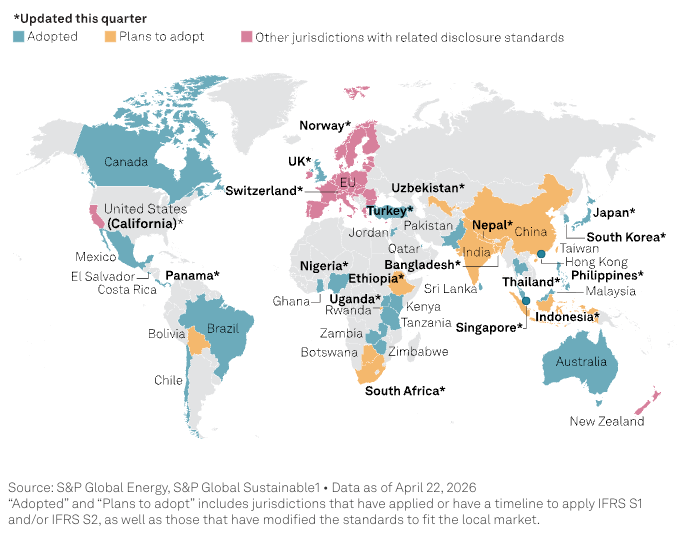
Both standards aim to improve the data quality, comparability and usefulness of environmental, social and governance information for investor and regulatory audiences. As of Q2 in 2026, a total of 40 jurisdictions have adopted ISSB standards and another 5 jurisdictions have standards that are at minimum “interoperable” with the standards, such as CSRD.
Interoperability between ISSB and CSRD standards
Both IFRS and EFRAG in the EU have worked together to provide guidance on how to align with both the ISSB and CSRD standards and avoid double reporting. This helps companies that operate globally and need to align with both sets of standards.
Interoperability suggests that the standards share common definitions of key terms and companies will not have to devote more resources to reporting to align with each standard.
Key similarities between ISSB and CSRD standards include:
- Shared definitions of key terms
- Financial materiality as a basis for some or all of the reported information
- Very similar climate-related disclosures: ISSB S2 and ESRS E1 have close alignment
For each standard, EFRAG has created a mapping document for similarities across the standards at the data-point level.
Companies still need to spend time to understand the key differences between each standard.
Key difference 1: Purpose of the ISSB and CSRD standards
CSRD's Purpose: The CSRD replaces the prior Non-financial Reporting Directive (NFRD) in the EU, which increased the amount and depth of information companies need to disclose. The aim was to improve the disclosures to meet both investor and stakeholder expectations for sustainability information. The information is therefore useful for decision-making with higher granularity of data and the inclusion of both positive and negative information across environmental, social and governance (ESG) topics, since most voluntary reporting focused solely on positive impacts.
CSRD was also developed as a way to integrate specific policy perspectives of the EU that distinguish it from other regions of the world. For instance, the ESRS are designed to align with several other key policies that form a regulatory ecosystem and sustainable finance roadmap, not simply a standard focused on corporate activities. These include:
- The EU's Climate Goals and Green Deal to cut emissions by 50% by 2030 and achieve net zero GHG emissions by 2050.
- The Corporate Sustainability Due Diligence Directive (CSDDD) for avoiding harms to the environment and human rights in direct operations and supply chains.
- The EU Taxonomy for sustainable finance, establishing definitions across sectors for what activities would meet specific investment labeling requirements to show climate ambition.
- The Sustainable Finance Disclosure Regulation applies to financial market participants in the EU and requires them to disclose whether investments fall under specific categories (Article 6, 8, and 9) to highlight the degree to which ESG information is considered. They also need to disclose how they consider their Principle Adverse Impacts on the environment and society through their investments.
While there are numerous other regulations that are part of the sustainability regulatory ecosystem of the EU, these regulations are deeply connected in their shared purpose and aim to move the economy towards a more sustainable model grounded in science and rigorous data.
CSRD initially applied to roughly 50,000 companies, but its scope was significantly reduced after the Omnibus Package I negotiations were complete. This simplification resulted in a roughly 90% reduction to the number of companies required to report under this standard, which is now less than 6,000.
ISSB's Purpose: In contrast to CSRD, the ISSB standards are being adopted globally at a rapid pace. ISSB was first established at COP26 with the aim of simplifying global standards for investors, to provide decision-useful data. ISSB took over administrative monitoring of the TCFD, SASB, IR and CDSB reporting frameworks and integrated their perspectives into its S1 and S2 standards.
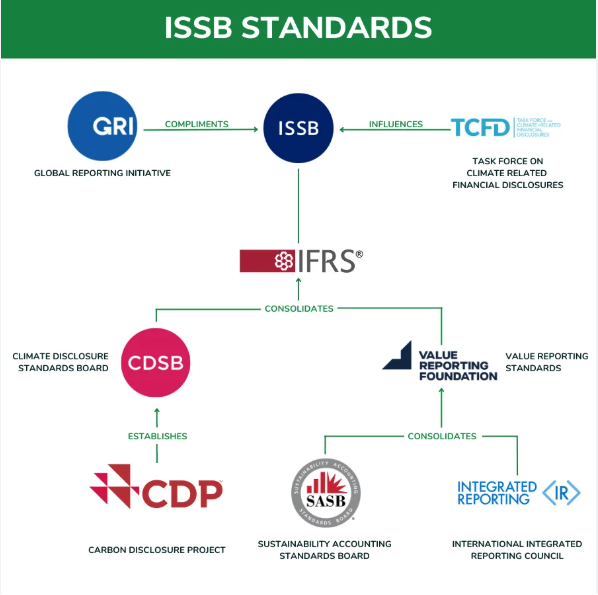
With leadership from the IFRS, widespread global financial reporting standards, the ISSB offered investors financially material data with data that could be integrated with financial reports. Since IFRS is already the main financial reporting standard used around the world, ISSB standards are easy for countries to adopt without the risk of misalignment with their financial reporting approach. This built in trust and the independent development of the standards, which doesn't prioritise the interests of any specific region, have supported their widespread adoption.
The structure of the standards makes them easy to implement in any jurisdiction, which can add its own special requirements on top of a baseline “building block” approach. Some countries have adopted them without any changes, while others have added their own requirements.
The flexibility and the global embrace of ISSB standards beyond the borders of Europe have made the standards undeniably influential on corporate reporting, specifically for disclosing carbon emissions and climate-related financial risks in the S2 standard.
Key difference 2: Double materiality vs financial materiality
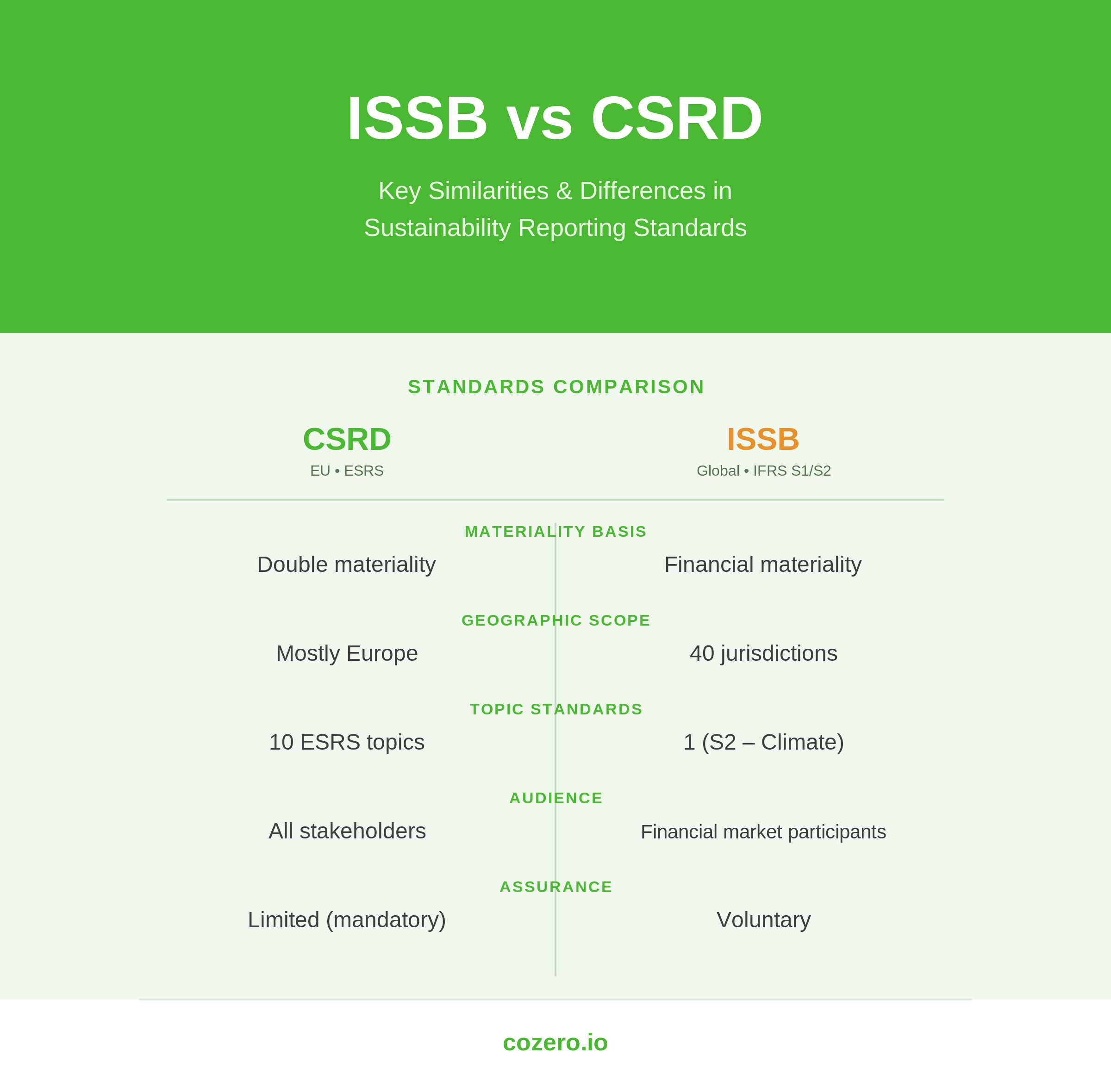
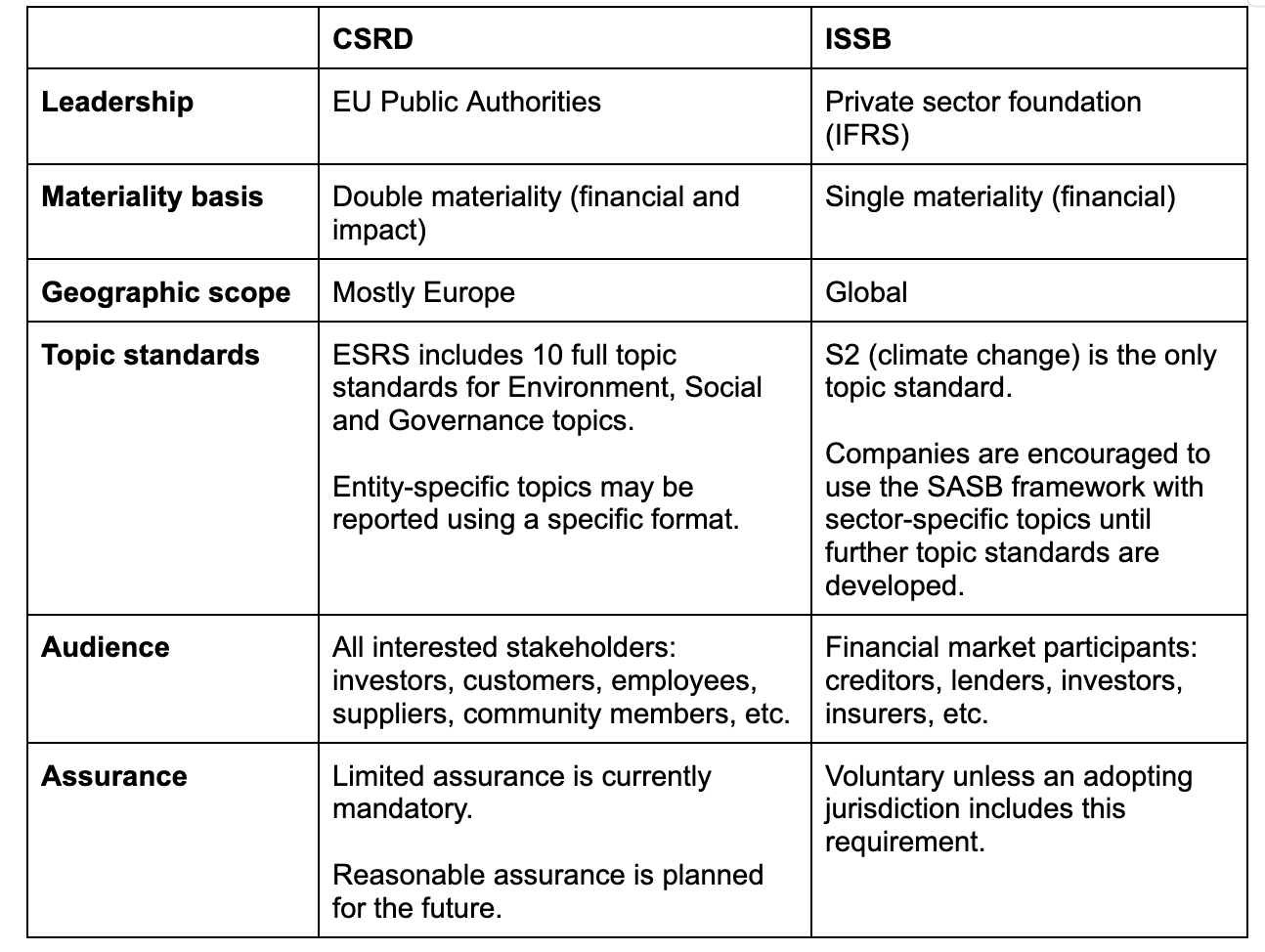
A key difference between CSRD's and ISSB's standards is that CSRD includes double materiality foundation and ISSB is solely based on financial materiality.
In ISSB standards, companies are expected to only report from a financial materiality “outside-in” perspective that considers any ESG issues that cause or could cause significant financial risks or opportunities to a business. This includes issues which could impact the prospects, profitability or position of a business. The aim is to provide investors, who are considered the primary audience of reporting from a financial materiality lens, with decision-useful ESG information. Financial risks and opportunities are priorities based on their magnitude, which factors their severity and likelihood. Risk management and business strategy approaches differ based on this prioritisation.
In the CSRD, companies must conduct a double materiality assessment to identify material environmental, social and governance issues to their business. Double materiality includes both an “inside-out” (impacts on society and the environment) and “outside-in” perspective. Double materiality considers that audiences may include multiple stakeholders.
The Global Reporting Initiative (GRI) voluntary standards serve as the main reference for impact-based materiality assessments. They include a focus on due diligence and consideration for the company's activities, business relationships, stakeholders, and sustainability context, when determining material topics. Actual impacts are assessed by severity and potential impacts are assessed by severity and likelihood under GRI. Severity includes the scale and scope of the impact as well as whether it is irremediable. This information helps companies decide whether remediation or stakeholder engagement are needed.
Several other national jurisdictions have also required a double-materiality perspective in their standards: India's BSRS and China's ISSB + impact materiality approach.
This key difference often produces staunch advocates of each approach, but in reality, the approaches are not mutually exclusive. Double materiality also includes the financial perspective, but it views the nature of sustainability reporting through both a due diligence and performance lens, prioritising relationships and human rights alongside business interests. Companies can still opt to adopt a double materiality perspective voluntarily if they operate in a jurisdiction where mandatory reporting focuses on financial materiality.
Key difference 3: Approach to Topic Standards
Another key difference is that ISSB so far has only one topic-specific standard, which is S2: Climate Disclosures. All other issues are expected to be addressed under guidance outlined in S1. This could change in the future, but for now, it potentially creates an imbalance between the level of information presented on climate change compared to other topics.
In contrast, the ESRS include a total of 10 topic standards covering five environmental areas, four social areas and a governance topic standard. Any topics that don't fall under those topics or their sub-topics are expected to be disclosed following a similar format as an entity-specific disclosure that includes disclosing topic-specific policies, actions, targets and metrics that the company defines.
Table 1: ISSB and CSRD Comparison of Key Differences
How MNE companies report in practice: a multi-framework reality
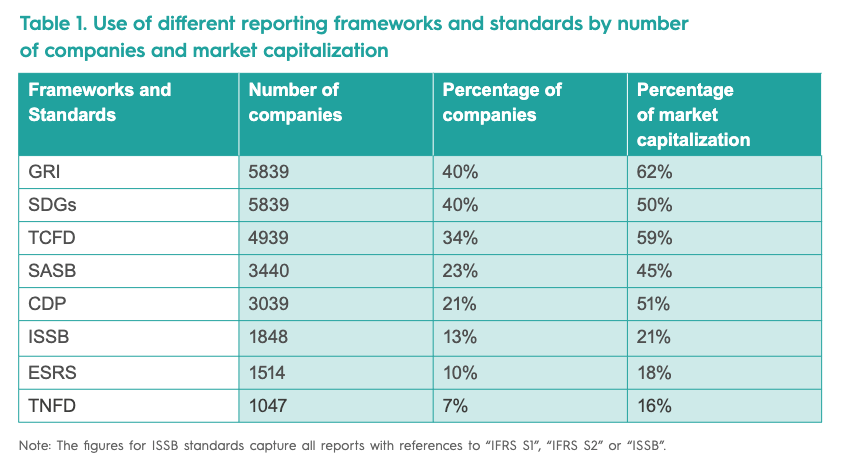
A recent report on the State of Sustainability Reporting from the Global Reporting Initiative reflected how companies adhere to multiple standards at once. This reality underscores the fact that there is no one-size-fits-all standard. Even if a company predominantly adheres to ESRS, it may also reference other standards to define its entity-specific disclosures or use them as a reference point for how it conducts materiality assessment, none of which have a prescribed approach in the standard.
One of the reasons for this is that many larger companies have adopted a voluntary corporate reporting approach for years before mandatory standards were adopted. During this phase of widespread voluntary reporting, largely starting around 2000, GRI Standards became one of the most popular standards for reporting sustainability information. Its focus on an impact materiality lens limited the usefulness of sustainability reporting to investors, however. Disclosures varied widely in format, depth and consistency, and no external assurance was required.
Companies who became used to the GRI reporting format are hesitant to stop reporting this way, since some stakeholders may still expect it. According to the GRI's State of Sustainability Reporting analysis, 68% of EU companies report on their impacts using either GRI or ESRS or a combination of both.
As of 2025, the total number of reporting companies using different standards and frameworks is mapped below by GRI. It will be interesting to track these reporting trends over time as more mandatory framework standards aligned to ISSB enter into force.
Zooming in on ISSB and CSRD climate disclosures
Where CSRD and ISSB really align is their emphasis on financial materiality, specifically for climate-related material risks and opportunities. This emphasis directly responds to investors needs for integrated reporting that allows them to draw insights across both financial statements and sustainability disclosures.
Similarity across the key sections of ESRS E1 are available in the ISSB S2 for climate disclosures relates to the following issues:
- Financial position, performance and cash flows
- Climate resilience and scenario analysis
- Risk management for physical and transition risks
- Metrics and targets
- Climate transition plans
Both standards require companies to report their Scope 3 emissions, climate targets and climate transition plans if available, climate-related physical and transition risks, and areas of connectivity to their financial statements.
Cozero excels in helping companies report the financial risks and opportunities of their carbon emissions activities and data in standardised, traceable formats. This analysis can integrate both into financial control processes as well as in climate transition or initiative planning. In addition to supporting reported outputs, we put the tools in companies’ hands to uncover even more strategic insights than reporting requires. There is real value in digging deeper to identify the financial effects of carbon emissions using our strategic carbon data intelligence tools.
Get in touch with our experts to learn more.
Related articles
Internal Carbon Pricing: A Practical Path to Carbon-Adjusted EBITDA