Internal Carbon Pricing: A Practical Path to Carbon-Adjusted EBITDA
Companies are increasingly turning to internal carbon pricing (ICP) to measure carbon-adjusted EBITDA, roughly 14% of listed companies globally. Since standard EBITDA excludes capital costs and can overstate profitability, adjusting it for carbon costs, the same way companies already adjust for interest rates and taxes, reveals a company's true financial position using a forward-looking logic.

Get instant access
Link
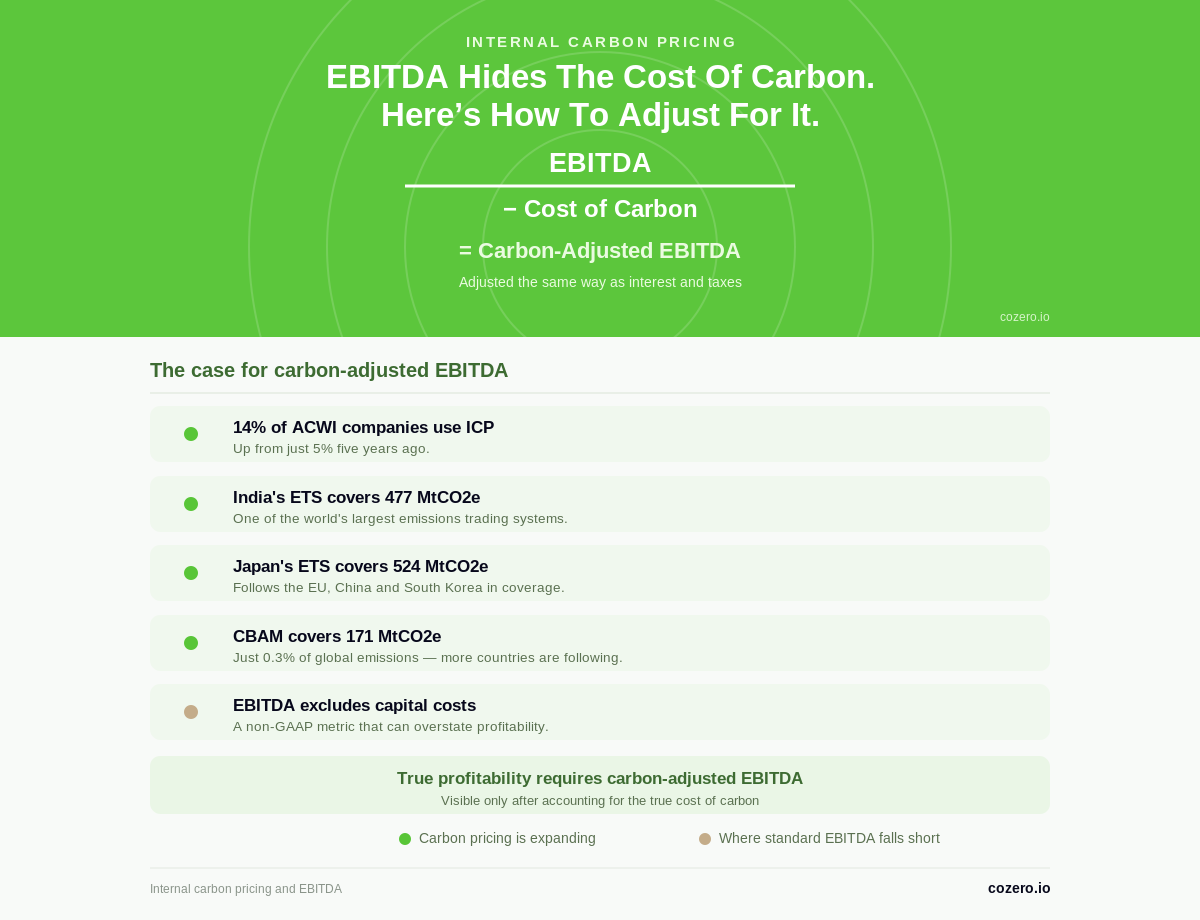
Internal Carbon Pricing is currently just used by 14 percent of MSCI All Country World Index (ACWI) companies reported using an internal carbon price, up from 5 percent five years ago. However, these companies are better positioning themselves to understand their risks from carbon emissions externalities that may not yet be adequately priced in global markets.
Carbon pricing mechanisms around the world are increasing, but they remain fragmented and they are still in their initial phases of implementation in many areas. India and Japan have launched two of the world's largest emissions trading systems (ETSs) with an approximate coverage of 477 million and 524 million tonnes of CO2e, respectively. These systems follow the EU, China, and South Korea in absolute GHG emissions coverage.
Even though the embedded GHG emissions of EU imports covered by CBAM were just 0.3 percent of global GHG emissions (171 MtCO2e), more countries are launching their own CBAMs. Now that Emissions Trading Systems and Carbon Border Adjustments are expanding beyond the EU, not only are companies’ own carbon emissions exposed to pricing mechanisms, but the emissions across their entire supply chains could be impacted.
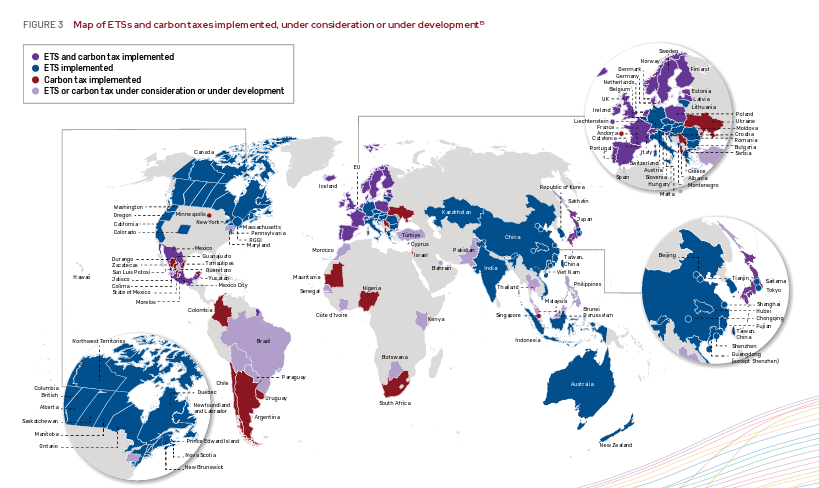
World Bank Group: “State and Trends of Carbon Pricing 2026”.
Adjusting EBITDA using internal carbon pricing is a specific way that companies can use a proxy to hedge against sudden readjustments based on market shifts or new regulations related to climate change. This approach helps companies manage risks, develop assumptions when and where opportunities will emerge, and build a more resilient strategy.
Companies Should Evaluate Carbon-Adjusted EBITDA to Hedge Risk
Companies and investors alike use metrics like EBITDA to evaluate firm-level financial performance. EBITDA stands for earnings before interest, tax, depreciation, and amortisation, and it is a non-GAAP metric, meaning it is not defined or incorporated into GAAP or IFRS accounting standards. Still, many lenders, investors, boards, rating agencies, valuation professionals, management teams, and analysts use it to inform decision-making.
EBITDA excludes capital costs, taxation, and non-cash expenses, potentially distorting how profitable a company appears. For this reason, many companies use cost-related adjustments to EBITDA to estimate a normalised, clearer view of a company's ongoing profitability. Most categories of adjustments, like one-time adjustments or run-rate adjustments, relate to costs that are not captured due to the timing of their impact.
Costs related to carbon emissions may also warrant adjustments that many companies overlook. Carbon pricing mechanisms have expanded significantly around the globe, but some regions still do not price carbon emissions through an emissions trading system or carbon border adjustment. This creates a risk for future re-adjustments.
Latency of impact can also affect the evaluation of climate-related investments, which often have high up-front costs with rising long-term return on investment expectations. However, many companies fail to evaluate the risk of delayed action, which may impose even higher costs later on and come with heightened risk as demand shifts can make inventories and assets less valuable.
Companies’ true profitability only becomes visible after adjusting for the cost of CO2 emissions.
Controlling carbon emissions costs is becoming increasingly challenging and complex as global supply chains are affected and unpriced risks remain exposed to the potential for sudden adjustments. Getting ahead of these invisible impacts on business performance now will better position them to navigate economic uncertainties.
Uncertainty and Volatility are Risks to Manage, not Reasons to Omit Financial inputs
Many companies view uncertainty and volatility as reasons that climate-related indicators like carbon prices produce low-confidence insights that can't be used to inform decisions. However, it is precisely the uncertainty and volatility of climate change that makes the financial analysis of carbon-related costs even more important.
Volatility makes inaction as well as carbon emissions reduction both sources of risk. On the one hand, growth in global climate-related carbon taxes, emissions trading systems, and questions about timing clean technology investments related to pricing and payback periods impose costs on high-emissions business models, while aiming to incentivize decarbonisation. Carbon prices can accumulate over time across regions and degrade profitability measured as EBITDA without adequate visibility into the carbon cost dynamics.
A “wait and see” approach offers no more of a safety net than a proactive approach, because both inaction and action alike can lead to economic risks. Energy price shocks, supply chain risks and consumer demand shifts related to inflationary pressures are now affecting businesses who waited too long to launch a climate strategy.
Both cases, integrating costs and adjusting for future volatility are core considerations for integrating climate-related risks and opportunities into a corporate strategy.
Using Internal Carbon Prices to Reveal Investment Opportunities
With a highly volatile outlook for climate transitions, companies can soften the ups and downs with internal carbon pricing as a proxy to soften the effect of unpriced risks. However, there is no one-size-fits all approach to evaluating and setting an internal carbon price, as the figure depends on the business industry, supply chain complexity, and emissions profile. Identifying material emissions sources and sector-specific exposures is key to understanding risks and opportunities alike.
Industries that are regulated by the EU Emissions Trading System (ETS) already have a clear carbon pricing signal impacting their decisions. However, many companies still treat carbon pricing simply as a simple financial cost rather than an opportunity to avoid emissions. Using carbon pricing to adjust EBITDA can reveal more strategic opportunities to optimise profitability by both reducing carbon emissions and developing products and services that help customers avoid emissions.
Companies that are not covered by the ETS could still feel the impacts of carbon pricing mechanisms through costs that are passed onto them. Operating in different markets also exhibits fragmentations, with some regions carrying externalized carbon costs that could lead to the adoption of carbon pricing mechanisms.
Supply chain complexity enhances the challenge of interpreting the impact of fragmentation, because of the multiple overlapping regulatory signals affecting supplier relationships and pricing. In terms of emissions profiles, Scope 2 emissions may represent a lower cost than Scope 1 and Scope 3 emissions, which can be harder to reduce depending on the industry. Adopting a Scope-based carbon pricing approach may offer a more realistic way to adjust EBITDA.
Companies can gain important insights from the exercise to establish an internal carbon price that directly relates to their material sources of emissions. This helps them evaluate how trade-offs between profitability and high emissions create greater risks of readjustment and where locked-in or hard-to-abate emissions sit across their supply chains.
Once your company has set an internal carbon price, it can be used to build a business case for financial allocation into carbon emissions-reducing projects, instead of solely basing your strategy on purpose-driven targets. In other words, an internal carbon price can be used to evaluate risk, guide opportunity, and future-proof portfolios. It both helps identify competitive advantage and avoid the risk of losses as more jurisdictions respond to climate change through their policies.
Integrating Carbon Emissions and Financial Control
The open question is whether your company treats the cost of carbon as genuine business intelligence. Carbon emissions should factor into capital allocation the same way companies factor in interest rates and taxes. Identifying the material risks of carbon emissions for transitions and integrating voluntary internal pricing into your strategy helps reframe the role of carbon emissions avoidance as a forward-looking opportunity.
Here are four key questions to determine whether your company could benefit from setting and evaluating internal carbon prices within your business strategy.
- Are you treating the cost of carbon as an input into financial analysis?
- Does carbon pricing weigh into your capital allocation decisions?
- Have you explored different scenarios to estimate how a business-as-usual scenario would affect your business differently than if climate policies are suddenly adjusted?
- Do you have a way to share financial evaluations of internal carbon prices with your finance team?
If you answered no to any of these questions, Cozero could fill this gap by giving you the appropriate translation layer to control your carbon emissions with an internal carbon price.
Using our platform, companies can build scenarios that show how EBITDA performs under different external conditions and based on their carbon pricing assumptions. Cozero's platform presents scenarios in a dashboard where companies can model the impacts of internal carbon pricing on their climate strategy and plans.
Get in touch with our experts to learn more.

Related articles