Where Absolute Emissions fall short, use Carbon Intensity Metrics
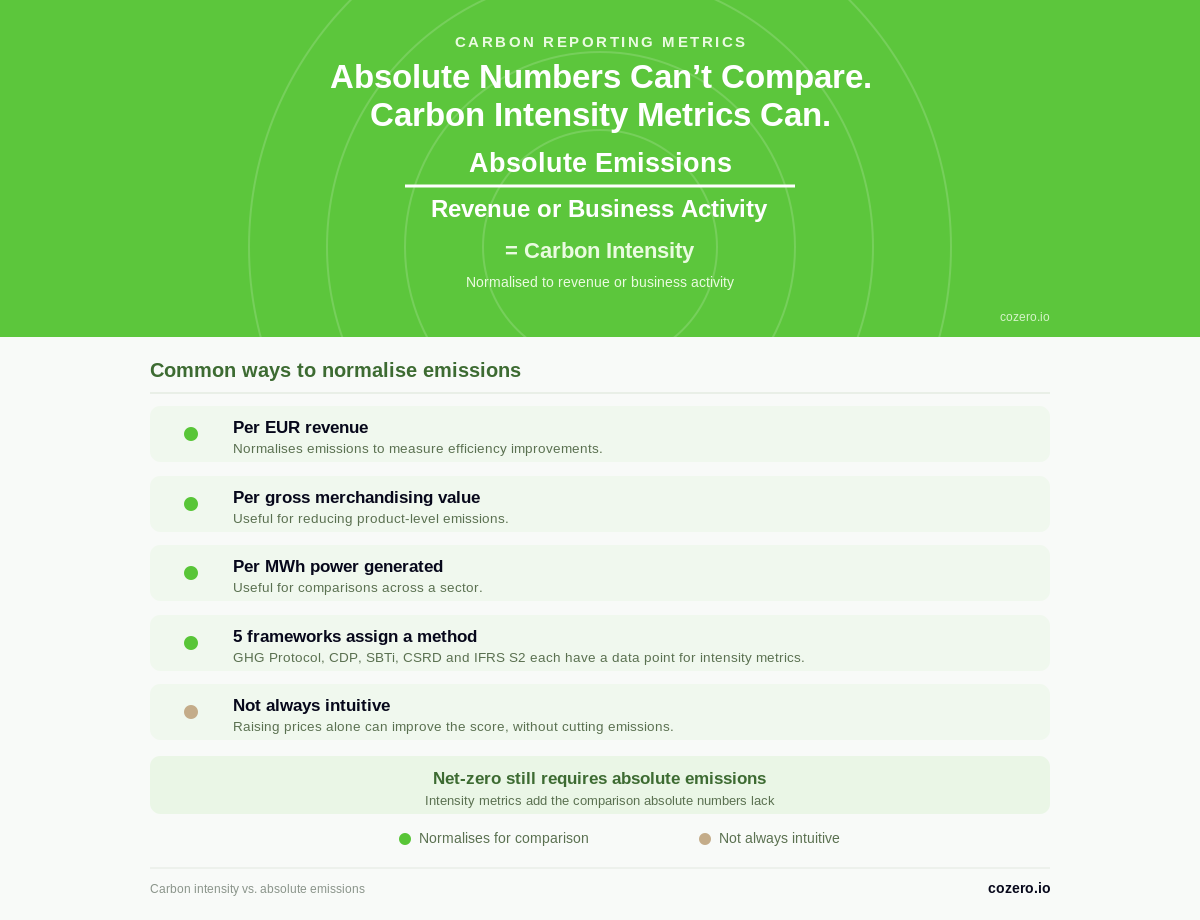
Absolute emissions track progress toward goals like the Paris Agreement, but they can't be fairly compared across companies without normalisation. Carbon intensity metrics solve this by normalising emissions against revenue or business activity, giving the comparative context absolute numbers lack.

Get instant access
Link
Absolute emissions are an important measurement for tracking progress against global emissions goals like the Paris Agreement. They also have important downsides: they don't enable apples to apples comparisons across companies. This requires normalisation.
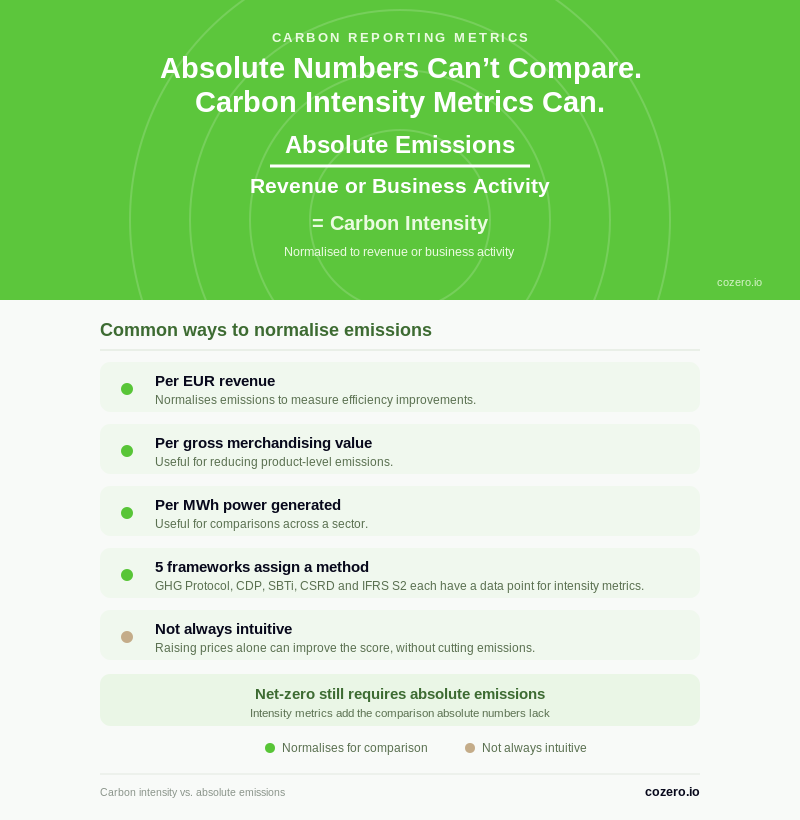
This is where carbon intensity metrics come into play. Carbon intensity metrics are normalised to business activity, revenue or other relevant performance metrics. Without this relative perspective, absolute carbon emissions measurements lack the comparative context needed to drive decisions.
Normalised metrics are built for comparisons, single measurement metrics are not
Normalisation isn't a single calculation of carbon emissions; it's a measurement that expresses carbon emissions relative to another figure expressing the scope of performance. Similar to the difference between population figures and per capita analysis, carbon emissions intensity metrics create apples to apples comparisons.
Normalised metrics are necessary for benchmarking performance against peers, otherwise there is no reasonable basis for comparison.
Carbon intensity metrics use cases that deliver real insight
They also help the C-suite drive key improvements over time. Here are a few examples of different use cases for carbon intensity metrics.
Emissions intensity metrics can be structured in numerous ways:
- Emissions per gross merchandising value, useful for reducing product emissions.
- Emissions per EUR revenue, useful for measuring efficiency improvements.
- Emissions per megawatt-hour (MWh) power generated, useful for sector comparisons.
GHG Protocol offers guidance on calculating GHG intensity metrics, something our Cozero Platform handles for you.
Each offers a different analytical lens and approach for developing business cases that drive emissions efficiency, while also tracking the planned efficiency performance against actual outcomes in scenarios.
See how our Act module enables scenario planning.
Investors are already measuring carbon intensity metrics
If investors are already measuring certain metrics of their investee companies, the C-suite should be measuring this internally, too.
For example, S&P Dow Jones Indices quantifies multiple carbon exposure metrics for its investee companies, including carbon efficiency and weighted average carbon intensity metrics, to help investors evaluate companies.
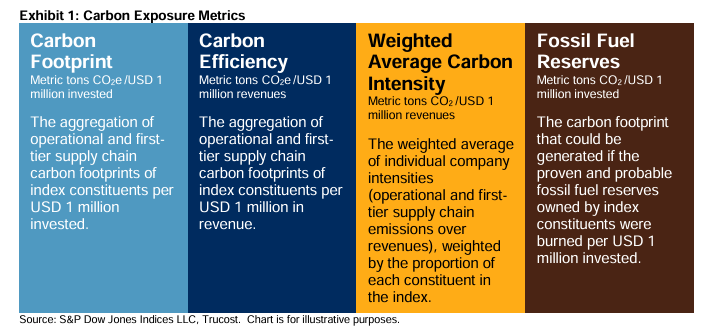
Investors increasingly have access to the data needed to estimate carbon intensity of companies. The C-Suite needs to bring its analytics capabilities up to speed to align with how investors look at their performance. Investors integrate multiple metrics for analysis to generate a holistic view of carbon emissions performance.
Different aims drive different evaluations: benchmarking performance against peers, understanding progress towards net-zero targets, evaluating how well companies are decoupling growth from carbon emissions, and understanding the efficiency of a company.
When to use carbon intensity metrics in financial planning
Carbon intensity metrics are great for adding a high-level carbon emissions perspective in conversations about financial growth and performance with C-suite leaders.
Carbon intensity metrics offer helpful comparisons between different growth models or supply chain decisions. This information can then be shared with investors.
Most carbon emissions reporting standards and frameworks have a method and data point assigned to these metrics: GHG Protocol, CDP, SBTi, CSRD and IFRS S2. This facilitates a standardised approach to communicating with both internal and external decision makers.
Apart from quantifying carbon emissions intensity at the corporate level, carbon intensity metrics can be used to compare the relative carbon emissions and financial performance of different sites, products or even month-over-month trend evaluations.
There is no need to merely default to an annual reporting period, as it is defined by reporting standards. Customised analysis is often most useful with metrics designed to capture strategic, relevant insights.
There are no one-size-fits-all metrics; multiple metrics are the best option
Only a variety of metrics can deliver a holistic view of carbon emissions.
While carbon emissions intensity metrics are helpful for relative evaluations, they are no substitute for absolute emissions when demonstrating progress toward net-zero targets. Net-zero requires an absolute emissions basis of performance measurement, because climate mitigation depends on actual reductions.
In addition, carbon intensity metrics are not always intuitive. A decrease in carbon emissions intensity doesn't necessarily mean better performance. If you increase the price of a product when measuring carbon emissions per merchandising value, the product may appear more efficient. Actually, it just costs more.
C-Suite decision makers need to understand when emissions metrics are useful and in which contexts they fall short. Hand-selecting relevant metrics is easy with Cozero's Act module where a wide range of analytical options are available for decision-useful information.
Get in touch to learn more.
Related articles