Cozero Intelligence in practice: checking your carbon footprint before it is published
See how Cozero Intelligence, our AI assistant for carbon data, checks a footprint before it is published: missing data, outliers and recent edits.

Get instant access
Link
Cozero Intelligence and the yearly sign-off
Cozero Intelligence is our new AI assistant for carbon data. You ask a question about your footprint in plain language, and it answers from your own data in Cozero Log, with charts, tables and the date of the data behind them. Every figure is calculated from your own entries, and the AI writes the explanation around it. Here we show it at work in one of the moments that matter most to a sustainability team: the yearly sign-off.
Once a year, someone has to confirm that the footprint is complete and that nothing odd slipped in, before its figures are published in the sustainability report and, for many companies, before they go to an auditor. The figures signed off then are also the ones reduction targets and discussions with finance start from.
The use case: Katharina checks her 2025 figures
Katharina is group sustainability manager at a family-owned machinery manufacturer near Cologne, with plants in Germany, Spain, Portugal and Italy. Each plant has someone who enters its fuel, electricity, materials and travel, and they have been importing and editing entries all year. In December the company publishes its first voluntary sustainability report, and before that her 2025 figures have to be signed off.
Without Cozero Intelligence, she would open every plant in Cozero Log and compare it with last year's spreadsheet.
Katharina and her company are invented, and so is the data. The questions are real, and the cards and answers are built from what Cozero Intelligence returned on that data, for a machinery manufacturer of about 1,900 employees.
Question 1: is anything missing or out of line?
She opens Cozero Intelligence, sets the timeframe to last year and types: “Before I sign off 2025: are there locations or months with no data, and any entries that look out of line with the rest?”
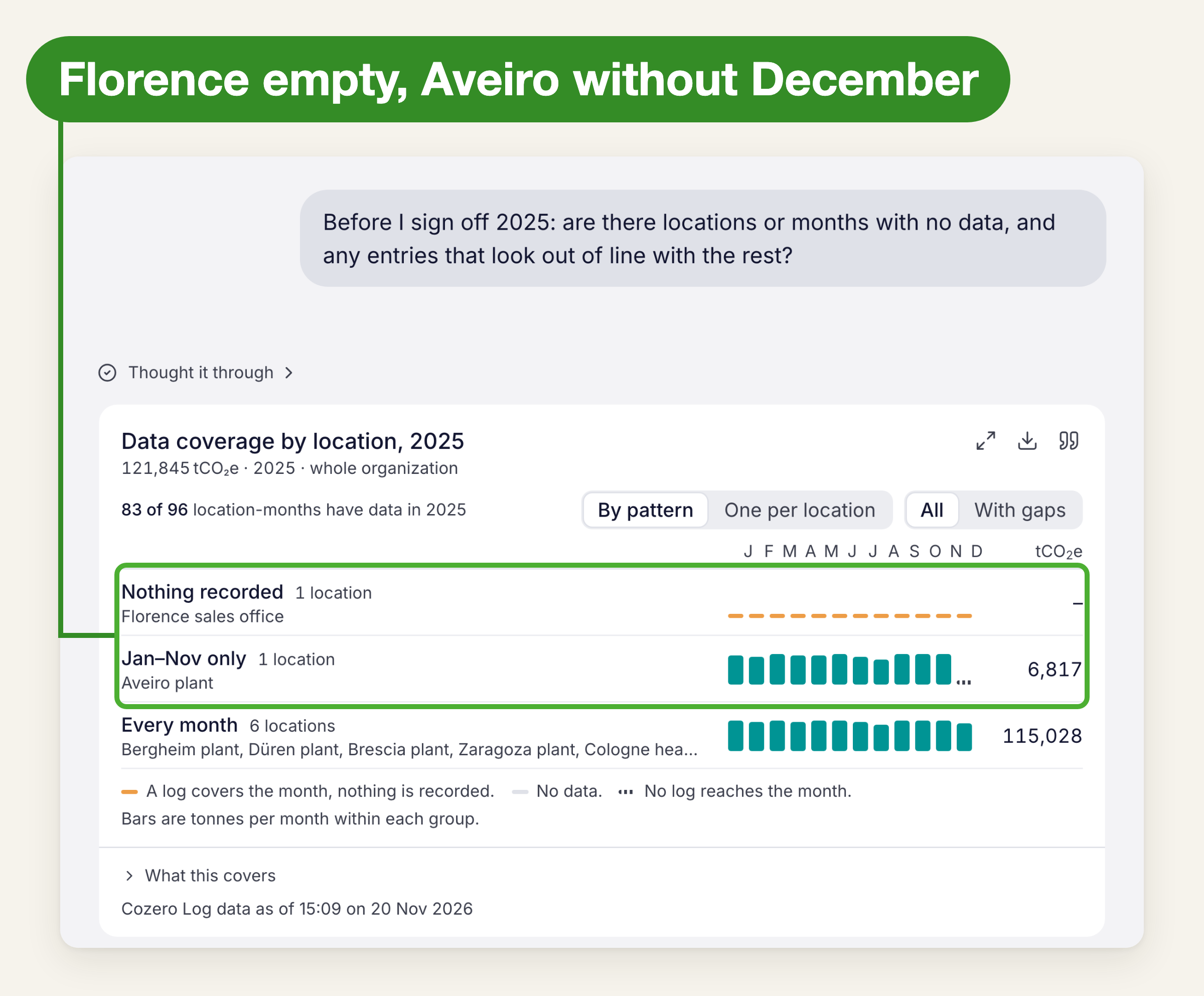
The answer comes back as two cards. The first shows which months have data at each location: 83 of the 96 location-months. Six locations have entries in every month. The Florence sales office has no data for any month of 2025, and the Aveiro plant has nothing for December. Neither gap would show in the group total of 121,845 tonnes of CO2e.
The second card lists the months furthest from their usual level. Diesel at the Bergheim plant leads, at 234,922 litres in January against a usual 28,735 litres, 8.2 times the usual level. The three other months it flags are August dips of 0.8 to 0.9 times usual.

Question 2: what is behind that figure?
Katharina asks for the entries behind it: “Show me the entries behind Bergheim plant diesel in January 2025. Is anything there I should check before I sign off?” Three entries make up the month's 590 tonnes of CO2e. One of them, from the engine test benches, holds 552 tonnes on its own: 219,600 litres, where a usual month at the plant is under 30,000. The other two are the same forklift entry of 7,661 litres, and the card flags that one entry appears more than once. The answer names two things worth checking before sign-off: the 552-tonne entry, against the plant's fuel records, and the two forklift entries, which may be the same fuel entered twice.

Question 3: what changed since the end of September?
Her last question looks at the most recent weeks: “What changed in our emissions data since the end of September, and which entries were added or edited?”
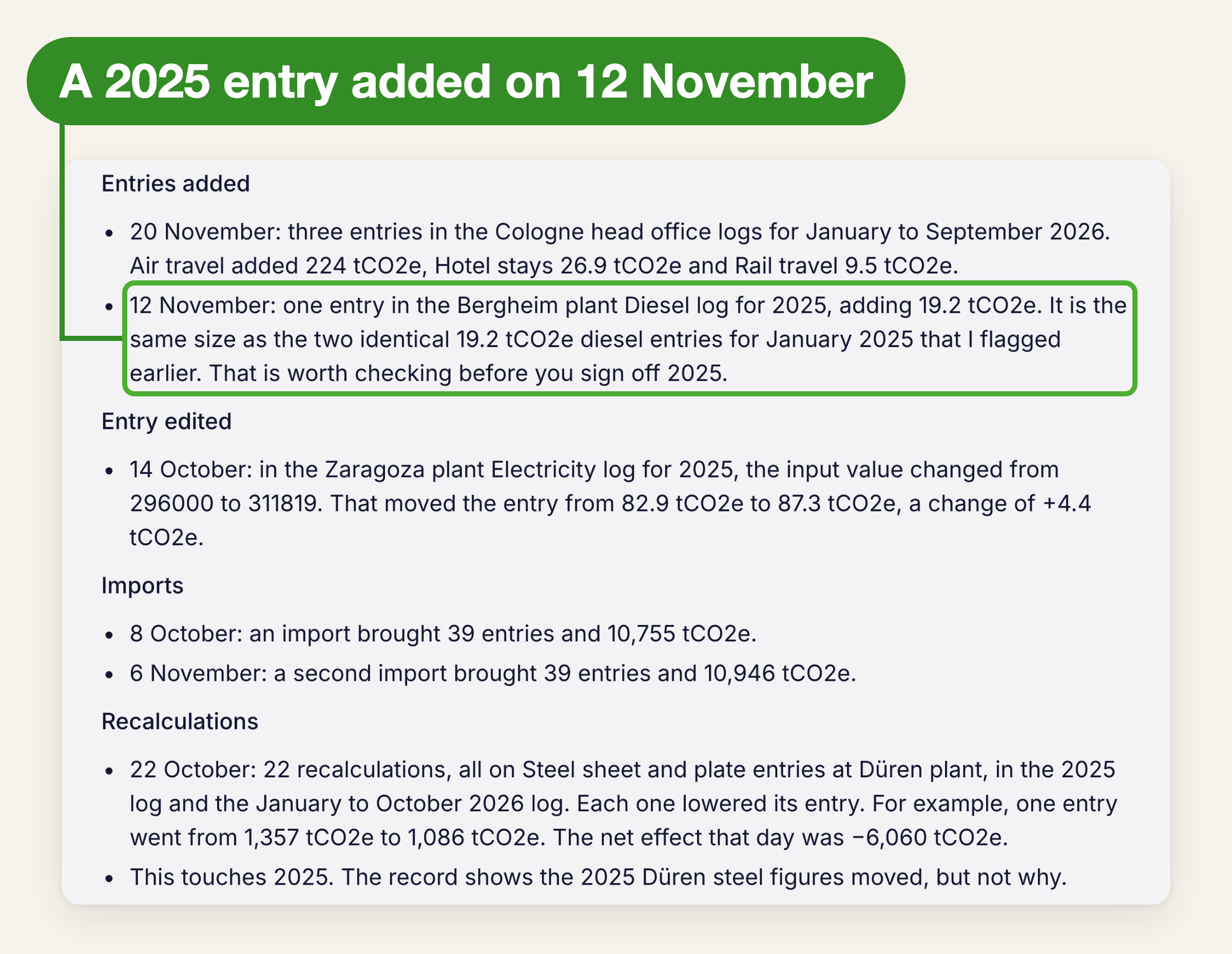
The answer lists what was added, edited, imported and recalculated, with the values before and after. Three changes touch the year she is about to sign off. On 12 November a 2025 diesel entry was added at Bergheim. It matches the forklift entry that appears twice, and the answer flags it as worth checking before sign-off. On 14 October the Zaragoza plant's 2025 electricity was edited, adding 4.4 tonnes. On 22 October the Düren plant's steel entries for 2025 and 2026 were recalculated, lowering them by 6,060 tonnes in total.
What Cozero Intelligence does and does not do
Cozero Intelligence reads only the data a person can already see in Cozero Log, changes none of it and shows the date of that data on every answer. Its answers also say where they stop. It flags months that look far from usual without calling them errors, and it shows where a change sits without saying why: for the Düren recalculation, it notes that the record gives no reason.
What she leaves with
Katharina leaves with a short list of things to check or fix before the figures go into the report: the Florence sales office with no data, the missing December at Aveiro, the 219,600-litre diesel entry, the forklift entry entered twice and the Düren steel recalculation. It took three questions in one conversation instead of a plant-by-plant comparison with last year's spreadsheet.
In our Carbon Management Roadmap, this check belongs to the first stage, data foundations.
Cozero Intelligence is coming to Cozero customers.
Before your next sign-off
See this check in a demo, with the questions you ask before signing off a year.

Related articles
Connecting Carbon Emissions and Financial Statements using IFRS Accounting Standards
Internal Carbon Pricing: A Practical Path to Carbon-Adjusted EBITDA