Connecting Carbon Emissions and Financial Statements using IFRS Accounting Standards
The connection between financial reporting standards and climate-related financial effects remains underexplored. Most businesses lack a clear view of how carbon emissions risks and opportunities actually show up in their financial statements. To close this gap, we share how carbon emissions issues map onto specific IFRS and IAS standards so finance and sustainability teams can collaborate more effectively.

Get instant access
Link
While sustainability standards have been maturing towards enhanced financial integration, the relationship between financial reporting standards and climate-related financial effects has not received enough attention.
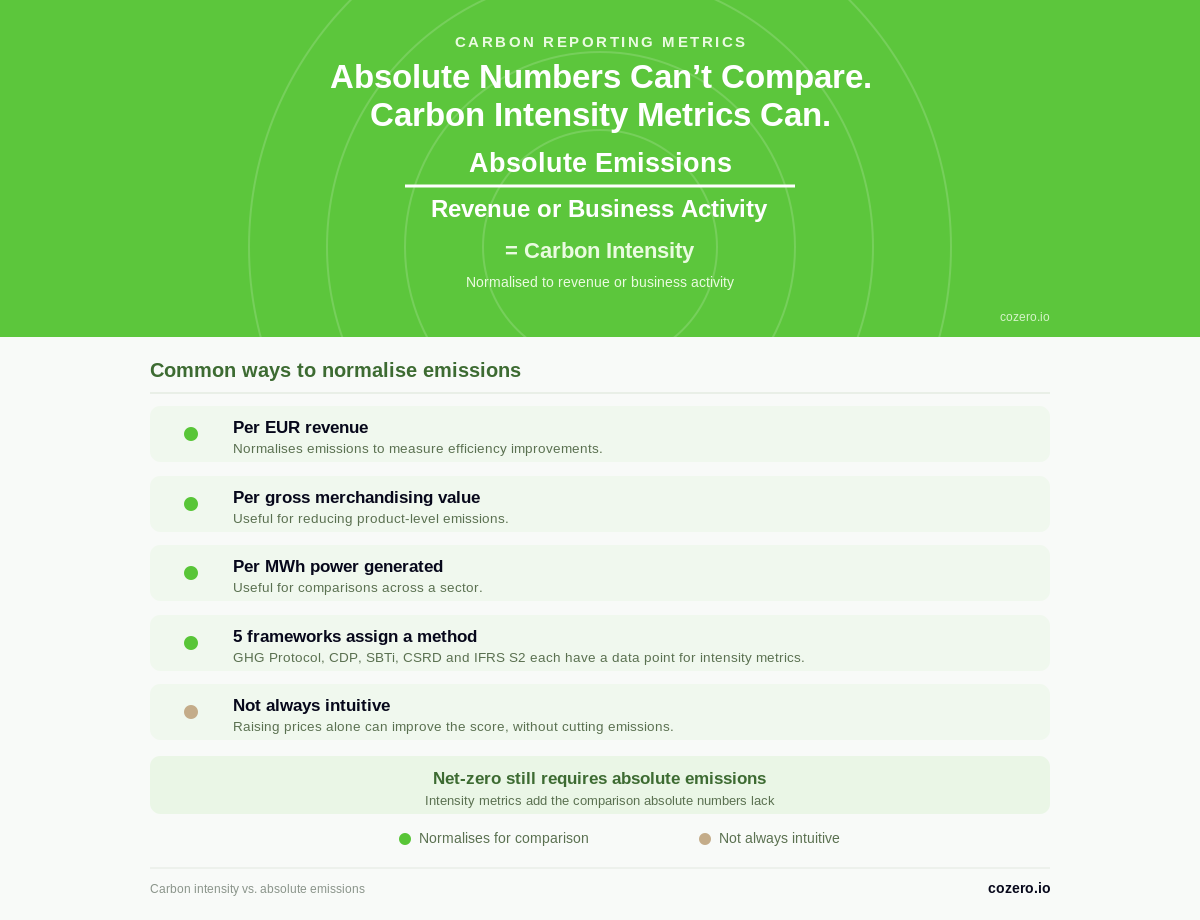
Most businesses aren't yet connecting carbon emissions and financial statements
This doesn't mean regulatory, technology, contracts or demand shift issues related to decarbonisation aren't affecting financial performance. It just means companies and investors don't yet have a clever view of how climate-related value, risks and ongoing financial costs impact business.
Without integrated sustainability and financial connectivity, companies cannot effectively plan their capital allocation, cost controlling or sourcing strategy.
This level of integration is a natural next step for companies with climate-related ambitions like net zero targets or climate transition plans. By connecting carbon emissions to financial statements, companies can gain a realistic view of how climate ambitions, actions and actually impact their financial performance.
IFRS accounting standards: where to disclose financial effects from carbon emissions
Connecting climate-related risks and opportunities to specific line items in financial statements is essential to knowing where financial stakeholders will look for this information. Sometimes there is a disconnect that prevents investors and stakeholders from obtaining a clear understanding of a company’s financial performance and stability by knowing its true value, risks, and opportunities resulting from climate change.
Most countries in Europe and around the world use the International Accounting Standards (IAS) and the International Financial Reporting Standards (IFRS) to prepare their financial accounting statements, so we have used these standards as the basis for our analysis.
IAS 1 Presentation of Financial Statements and IAS 8 Basis of Preparation
What it requires: Disclosure of material uncertainties relating to events or conditions that could raise doubts about an entity’s ability to continue as a going concern or an explanation of why there are no relevant events or conditions leading to such uncertainties.
Connection to carbon emissions: Uncertainties of this type can come from decarbonisation-related compliance costs or the ability to manage them.
IAS 2 Inventories
What it requires: Reporting inventory, following a set of specific rules for measuring and accounting for inventory costs as assets until a sale generates revenue for those goods. The rules define how and when to report inventory expenses and when to account for adjustments to their net realizable value (NRV). NRV is an estimated selling price minus the cost of completion and selling.
Connection to carbon emissions: Consumer demand shifts related to emissions-related factors can impact the value of inventory. For instance, customers may start to avoid purchasing goods with high embodied carbon to avoid carbon border adjustment taxes and potential future liabilities in response to the EU's Carbon Border Adjustment Mechanism (CBAM) or similar measures in other countries.
IAS 12 Income Taxes / IAS 20 Accounting for Government Grants and Disclosure of Government Assistance
What it requires: IAS 12 defines how income is reported in relation to current and deferred income tax liabilities and assets (amortisation and depreciation), aligning taxes paid to the relevant reporting period. IAS 20 includes requirements for reporting and measuring the financial impact of government grants in financial statements.
Connection to carbon emissions: Taxes, tax credits and government grants related to decarbonisation would need to be reported either in IAS 12 as an income tax effect or in IAS 20 as a grant.
Governments currently issue multiple tax credits to incentivise decarbonisation. These activities often meet certain governmental criteria in exchange for tax credit incentives:
- producing green components locally.
- purchasing qualifying low-carbon emissions assets or equipment.
- investing in clean energy resources.
Any relevant action requires logical reporting of the tax credits issued in relation to whether they're refundable, non-refundable, transferable, or non-transferable. Grants also have relevant terms and conditions to accurately measure and report according to IAS 12.
IAS 16 Property, Plant and Equipment / IFRS 16 Leases
What it requires: These standards require companies to report details about specific assets, including their useful life or the residual value of assets.
Connection to carbon emissions: Emissions-related regulatory restrictions on the use or demand shifts leading to the obsolescence of the above assets can impact their useful life or residual value. Amortisation and depreciation rates may also be affected. Companies should evaluate and report these relevant issues under these standards.
IAS 36 Impairment of Assets
What it requires: Firms review their assets regularly and report impairment losses where they apply to avoid overstating asset values. Impairment loss is defined as when the carrying amount exceeds the recoverable amount.
Connection to carbon emissions: Emissions-related issues can be an indicator of impairment. Demand shifts away from high-emissions assets or climate-related regulations could lead to asset stranding or valuation shifts that affect recoverable asset values. Industries covered by Emissions Trading System can use the future prices of CO2 emissions certificates to estimate recoverable asset or cash generating unit amounts.
IAS 37 Provisions, Contingent Liabilities and Assets
What it requires: Companies should report potential future obligations and uncertainties in their financial statements. This standard outlines how to appropriately do so.
Connection to carbon emissions: Carbon emissions regulations could lead to contingencies that have a financial effect on a firm's assets and liabilities, such as penalties or fees for failing to meet targets or comply with reporting requirements, meet contractual agreements as inventories change, or meet new product standards linked to carbon emissions.
IAS 38 Intangible Assets
What it requires: This standard shares how to report, measure, and amortise intangible assets.
Connection to carbon emissions: Research and development investments for climate-related innovation could qualify as intangible assets. In addition, some companies find their acquired carbon credits, used to meet their net zero targets, meet the definition of intangible assets.
IFRS 2 Share-based Payment / IAS 19 Employee benefits
What it requires: This standard outlines the requirements for reporting incentive schemes.
Connection to carbon emissions: Many companies use financial incentives, such as remuneration or shares to incentivise employees or management leaders to achieve climate-related targets. These incentives are reported in either IFRS 2 or IAS 19.
IFRS 9 Financial Instruments
What it requires: Companies need to follow these reporting guidelines on how to report financial instruments as assets or liabilities.
Connection to carbon emissions: Sustainability linked loans, green bonds and other instruments linked to carbon emissions performance would fall under this standard. The IASB amendments to IFRS 9 and IFRS 7 guide companies on how to report electricity contracts from energy sources that depend on nature (such as wind and solar). These include renewable energy power purchase agreements (PPAs) from variable energy sources, which may be used in a decarbonisation strategy.
IFRS 13 Fair Value Measurement
What it requires: Measuring and reporting the fair value of assets and liabilities.
Connection to carbon emissions: Changes in legislation, regulation, consumer demand, supplier behaviour based on carbon emissions can all affect fair valuation, and changes should be reported. Investor and lender behaviour changes can affect the availability of funding or financing costs. A clear example is the integration of climate risk factors by the European Central Bank (ECB) into corporate loan evaluations.
IFRS 18 Presentation and Disclosure in Financial Statements
What it requires: This standard requires companies to report any material information that may not be reported elsewhere in the financial statements.
Connection to carbon emissions: Carbon emissions and climate transition planning and climate-related risks and opportunities can affect a company's financial position and performance in ways beyond financial reporting standards. Companies should disclose these issues here.
Connect carbon emissions and financial statements with Cozero
Even though IFRS financial accounting standards don't directly address climate-related issues within individual standards, companies are increasingly aware that carbon emissions impacts are having financial effects. These effects should be reported directly in financial statements and controlled by CFOs.
The ETS, CBAM and other climate regulations can have direct, material financial effects on a company's financial performance. Companies can no longer view carbon emissions and their financial effects in isolation from their standard financial reporting.
Cozero's platform enables faster, more insightful ways of evaluating carbon emissions and financial performance together to guide meaningful financial planning within organisations. We are using our carbon emissions platform to automate analysis and connectivity between finance and sustainability reporting.
Get in touch to learn how to leverage our platform to gain control of the financial effects of carbon emissions.
Related articles
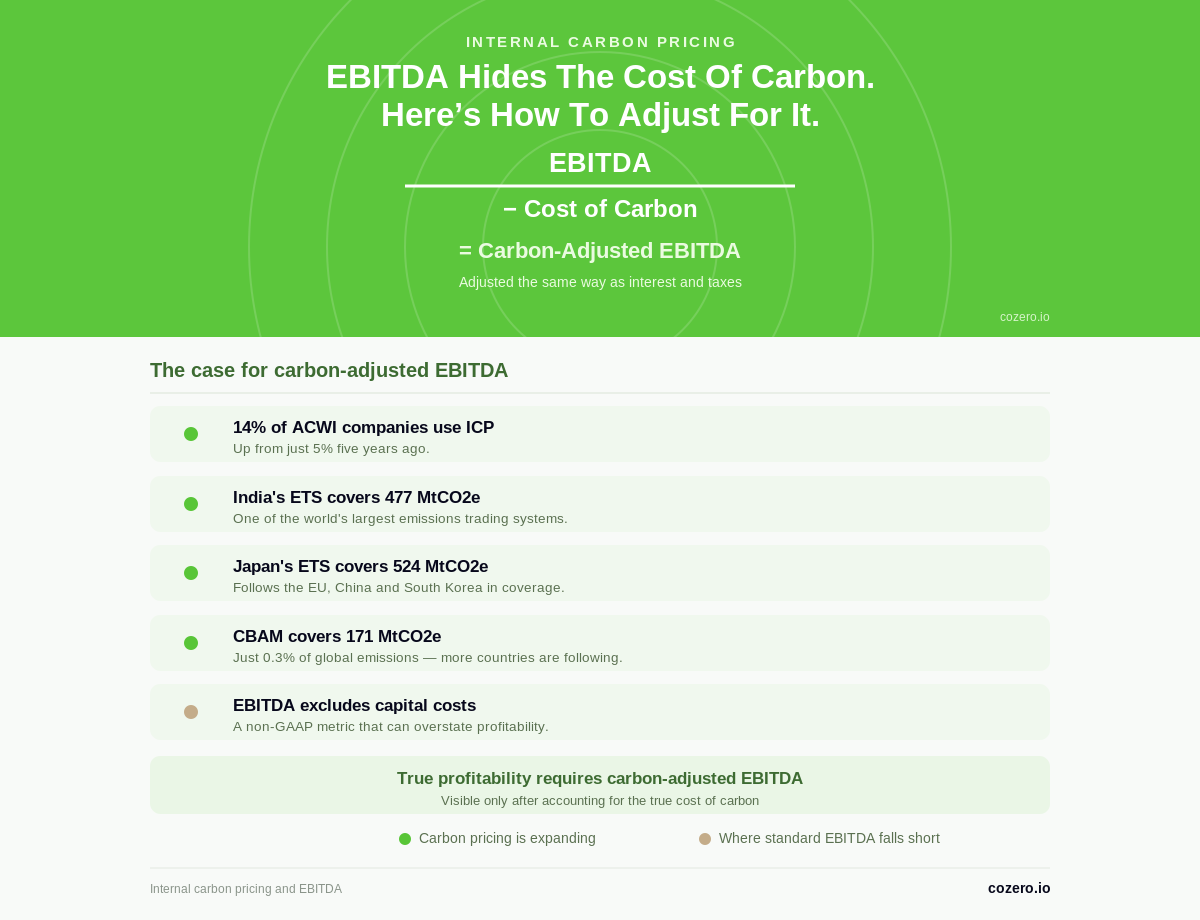
Internal Carbon Pricing: A Practical Path to Carbon-Adjusted EBITDA