Industriestrompreis: a decarbonisation budget is arriving. Make sure carbon decides how it is spent
The Industriestrompreis brings a real decarbonisation budget with a four-year deadline. Why carbon needs a seat at the table before it's spent.

Get instant access
Link
If your plant qualifies for the Industriestrompreis, you are about to spend money on decarbonisation, because the subsidy requires it. It lowers your power price, and in return it obliges you to reinvest at least half of the savings into decarbonisation measures within four years.
That is a real budget, on a fixed deadline. The question for sustainability is simple. Who decides how it is spent, and on what basis?
What the subsidy actually requires
The Industriestrompreis is a German scheme, approved by the European Commission in April 2026 under the Clean Industrial Deal State Aid Framework. It applies retroactively from 1 January 2026 to the end of 2028, with a total volume of 3.8 billion euros. The target price is around 5 cents per kilowatt hour, against roughly 14 today, on up to half of a company's annual consumption. The BAFA administers it, with applications expected from 2027.
The condition is the part that concerns you. At least half of the savings must go back into energy efficiency and decarbonisation measures, and the company has four years to invest and to document it. More than 90 energy-intensive sectors are in scope, from steel and chemicals to glass and semiconductors. Sources: Clean Energy Wire and Taylor Wessing, April 2026.
One scope note. This applies only to companies operating in Germany. Sites elsewhere are not covered.
The energy team already owns this list
The companies eligible for this already run a tight energy practice. Many are certified to ISO 50001, the energy management standard. Their efficiency improvement lists already exist and are prioritised, and those lists usually carry CO2 as one of the columns.
So the carbon numbers are not absent. Once these measures go in, the emissions reductions appear in next year's GHG inventory on their own, because the inventory is built on measured energy data. You will reduce emissions, and you will see it in the totals.
The gap is not visibility. It is the decision.
Where carbon falls out of the decision
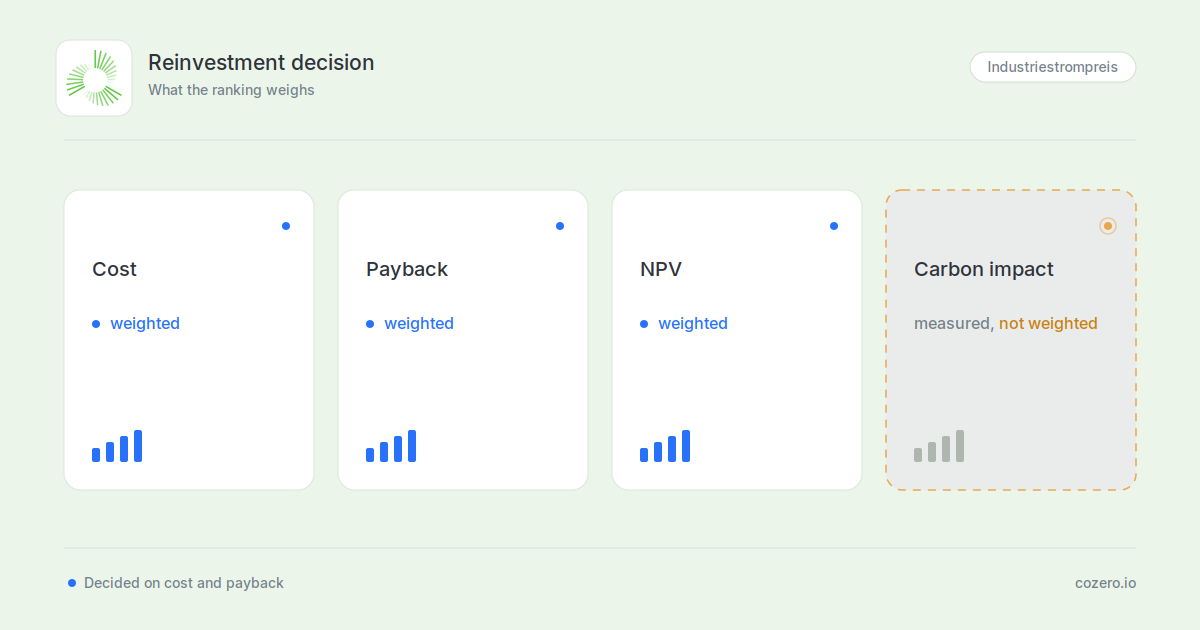
The energy department selects these measures on an energy logic: cost per kilowatt hour saved and payback time. Those are good reasons. They protect operating costs, and they are planned through with care.
What that logic does not do is treat carbon as a criterion. Two measures can cost the same and pay back at the same speed while delivering very different emissions cuts. On an energy ranking they look identical. On a carbon ranking, one is clearly the better use of the budget.
The consequence is quiet but real. The budget is finite. Rank it on payback alone and the measures with the strongest carbon impact can end up unfunded, or low on the list. The company still reduces emissions, just less than the same money could have delivered, and not always where its own targets need it.
This is the heart of it. The energy roadmap and the decarbonisation roadmap run on separate logic. The subsidy is about to pour money into the first. Unless the second is in the room, the two stay out of sync, and the company cuts emissions without steering where the cuts come from.
What you bring to the decision
Your role starts before the application, while the investment list is still open.
First, carbon goes into the ranking as a prioritisation dimension, next to NPV and ROI. Each candidate measure gets a quantified emissions effect and a carbon value, including the cost of carbon the company would otherwise carry over time. The list is then ranked on cost and on carbon together, not on cost alone. And because the effect is quantified measure by measure, you can report progress against your targets with evidence, support your CSRD disclosure, and build the next round on what actually worked, instead of staring at one aggregate number you cannot break down.
Second, the two roadmaps get synced. The measures the subsidy funds should advance the company's own decarbonisation targets, not sit in a parallel plan that no one reconciles. Then the same euros count twice: lower energy cost, and measurable progress on the trajectory you report.
The argument for your Geschäftsführer
It is short. A decarbonisation budget is arriving with a four-year clock. If carbon helps decide how it is spent, the company gets more reduction per euro and a cleaner story for its targets and its reporting. If it does not, the money still goes out, and the carbon outcome is left to chance.
The energy team's decisions are sound on energy and cost. Carbon is simply the one dimension they are not asked to optimise, and the time to add it is before the plan is fixed.
Before the list is locked
The window is now. Eligible plants are weighing whether to apply and drafting their reinvestment plans this year. That is the moment to put carbon into the ranking, while the measures are still being chosen.
This is where Cozero fits. The platform quantifies the carbon effect of each investment, attributes it measure by measure, and sets it alongside the financial case, so carbon becomes a real criterion in the decision rather than a number you reconcile afterwards. If your company is preparing an Industriestrompreis plan, that is the conversation to have before the list is locked.
Book a demo to see how Cozero fits into your Industriestrompreis plan.

Related articles