Climate Transition Planning Frameworks: A Comparison of Disclosure Requirements
There's still no harmonised definition for climate transition plans. We compare the key features of leading disclosure frameworks and remaining challenges.

Get instant access
Link
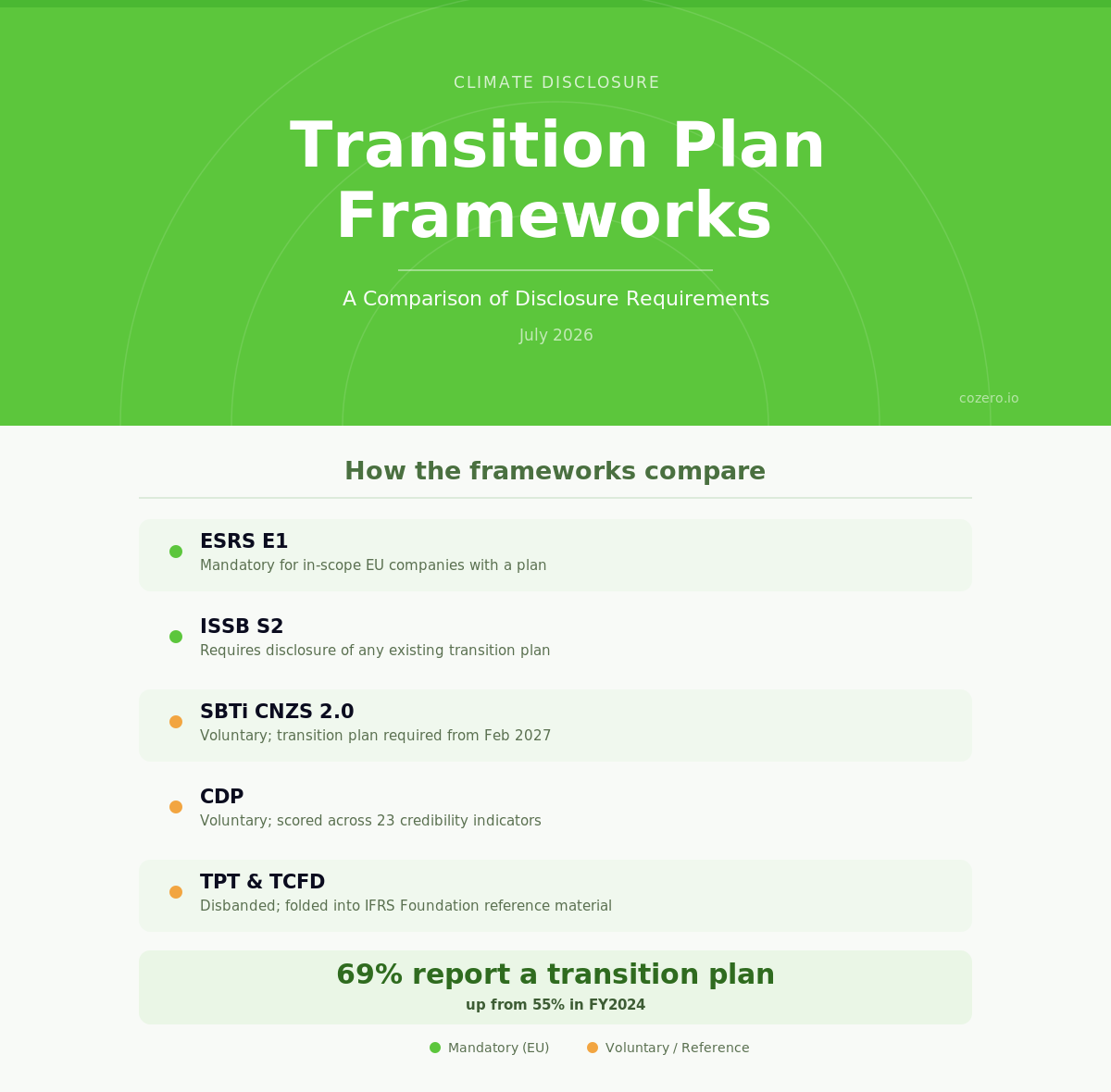
This year saw a sharp rise in the number of companies sharing climate transition plans with their sustainability statements. EFRAG's "2026 State of Play Report" assessed 905 sustainability statements from fiscal year 2025 that underwent third-party assurance under CSRD. Its findings show that 69% of companies reported having a climate transition plan in FY 2025, up from 55% the prior year.
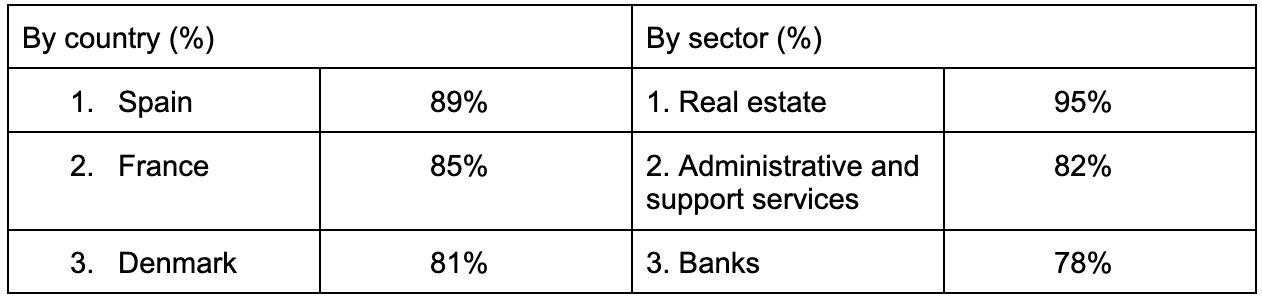
Table 1: Highest proportion of companies with transition plans:
The EU Corporate Sustainability Reporting Directive (CSRD) still requires companies to disclose transition plans after the changes brought by the Omnibus Simplification Package. This requirement applies if the entity has already developed one, and if climate change is a material topic to the entity. Currently climate change is deemed material by 99% of companies reporting in line with CSRD.
In contrast, the Corporate Sustainability Due Diligence Directive (CSDDD) no longer requires in-scope companies to disclose climate transition plans.
The Strategic Value of Climate Transition Plans
The strategic value of having a climate transition plan could also drive their adoption by corporations. Climate transition planning is the process of building a strategy to move a business toward a low-carbon economy, covering strategic and financial planning, governance, risk management, targets, and emissions data, refined further by regional and sector-specific transition pathways.
Rather than functioning as a standalone target-tracking tool, a transition plan should grow out of a company's overall strategy, helping bridge short-term economic pressures with long-term climate goals over a longer time horizon, since climate impacts reshape business outlooks and assets over decades.
While data gaps still create uncertainty, transition plans address this directly by requiring companies to state their assumptions clearly and weigh the risks of action against the risks of inaction. The plan therefore serves as a guidepost for decision-making amid political and economic volatility, and gives companies a way to monitor and adjust their expectations as circumstances evolve.
Climate Transition Plan Design Challenges
Currently there's no harmonised definition for transition plans across current frameworks, and effective corporate disclosure is still lacking. Nevertheless, core elements of climate transition plans have emerged.
A study comparing 14 climate transition plan frameworks in the Journal of Environmental Management showed strong convergence for these core areas:
- Linking decarbonisation strategies to business planning
- Financial alignment
- Governance structures
The study reviewed disclosures from 1400 individual disclosure requests within the frameworks, and grouped them into 13 components and 38 sub-components (see below):
Table 2: Climate Transition Plan Framework Map

Aligning transition efforts with financial planning has proven one of the strongest roadblocks to creating a comprehensive climate transition plan for companies. Plans often fall short of integrating into companies’ capital expenditures, R&D budgeting, and planning horizons, according to the study, which suggests structural challenges as well as practical ones.
For this reason, we compiled some of the most important climate transition plan frameworks for EU-based businesses to review their elements as a resource for comparison.
Climate Transition Planning Frameworks
Various global, mandatory and voluntary disclosure frameworks include disclosures and insights into climate transition planning best practices, including
- European Sustainability Regulation Standards (ESRS) E1 - Climate Change
- Transition Plan Taskforce
- International Sustainability Standards Board (ISSB)
- Science Based Targets initiative (SBTi)
- CDP (formerly Carbon Disclosure Project)
- Taskforce on Climate-related Financial Disclosures
ESRS E1 (Draft Simplified Standard)
As a requirement for in-scope companies that have a climate transition plan ESRS E1 (Draft Simplified ESRS, November 2025) outlines multiple requirements that generally align with prior frameworks like TPT. However, specific requirements directly reference other EU policies, making them regionally-specific.
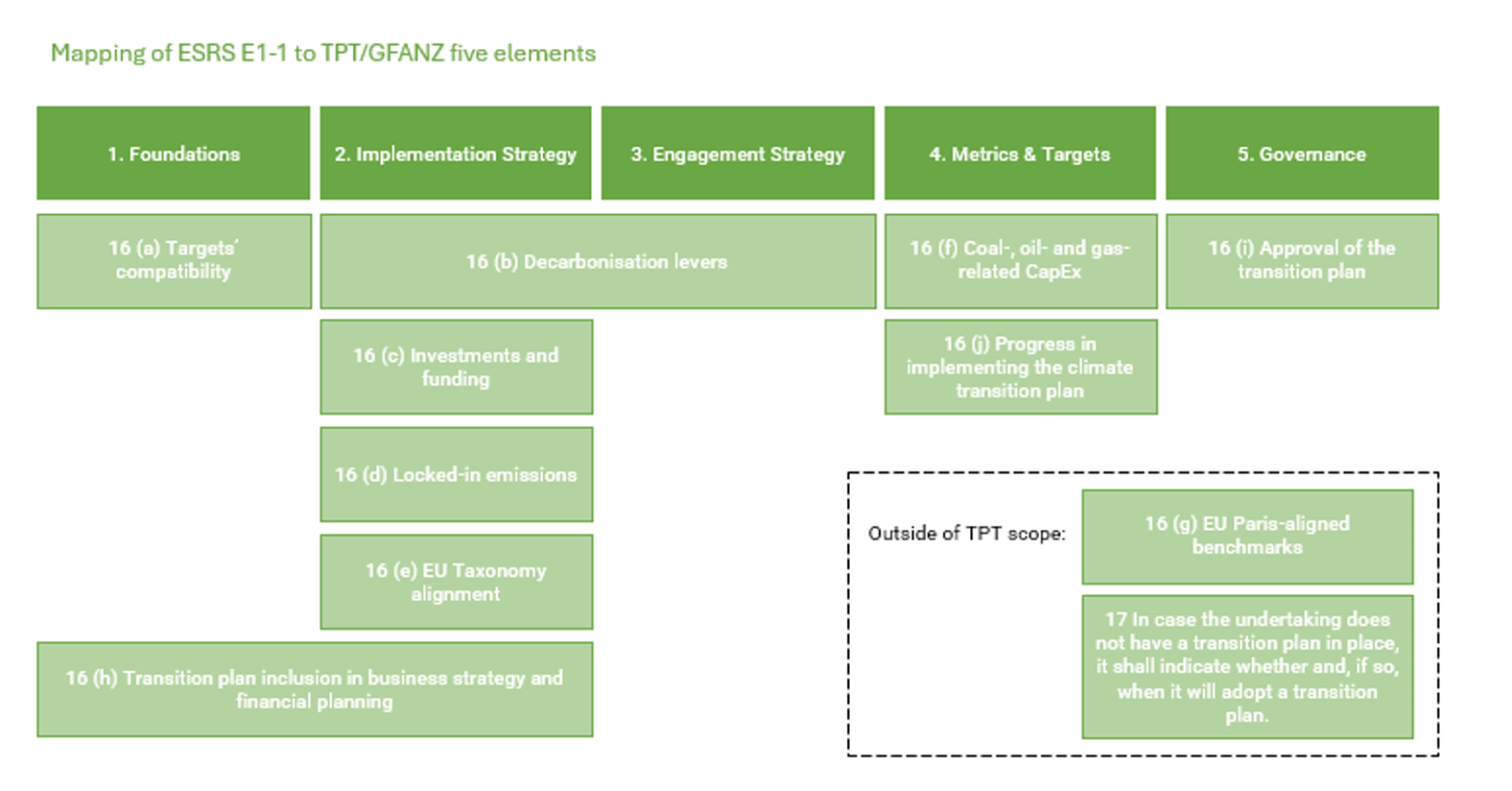
Main disclosures: Companies must disclose the key features of their transition plan, including:
- GHG reduction targets aligned to a 1.5°C warming pathway
- Decarbonisation levers
- Key action plans
- CapEx and OpEx investments made
- An estimate of funding needed to fulfill the plan
- Assumptions and dependencies
- An assessment of locked-in emissions risk
- Progress made implementing the plan
Disclosures must also cover the plan's approval by governance bodies and how it aligns with overall business strategy.
Unique disclosure requirements in ESRS E1:
- Any CapEx tied to coal, oil, or gas activities
- EU Taxonomy alignment
- Whether a company is excluded from EU Paris-aligned Benchmarks
These benchmarks describe certain percentages of high-emitting activities that disqualify companies from Benchmark inclusion.
Decarbonisation levers are typically reported using the EU's famous waterfall chart example. Many companies have adopted this visualisation style in their climate transition plans.

EFRAG Implementation Guidance
EFRAG's Climate Transition Plan Implementation Guidance remains paused since February 2025, due to the Omnibus package, but it could be developed further at a later time. The current guidance, which is not confirmed, provides more granular detail on the ESRS E1 requirements.
A complete plan must at least cover:
- GHG emissions reduction targets and actions
- Financial planning and alignment to the business strategy
- Governance approval
All of these issues are reviewed for consistency across the company's reporting. Guidance also emphasizes that plans should be forward-looking, span multiple time horizons (5-year near-term through long-term), include both quantitative estimates and qualitative narratives, and reflect economy-wide enabling activities like sector cooperation and policy advocacy.
EU Voluntary Standard: Additional climate transition planning advice from EFRAG tailored to meet the needs of European SMEs is available in a supporting guide for target setting and GHG emissions reduction.
TPT Framework
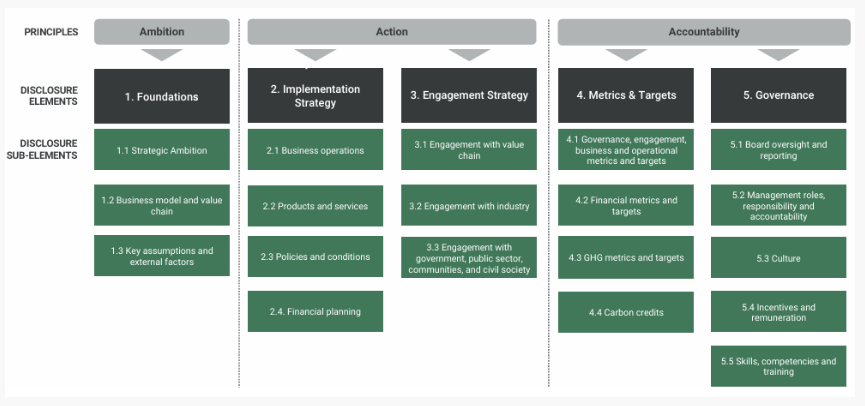
The TPT has been disbanded, with the IFRS Foundation taking over its disclosure-specific materials in 2024. The TPT's disclosure framework itself remains relevant and is structured around three guiding principles (ambition, action, accountability), five disclosure elements, and 19 sub-elements.
Many features of the TPT Framework have been integrated into the ESRS E1 standard, however, it still serves as a helpful reference for guidance on implementation. Both approaches require disclosure of decarbonisation levers, investment/funding information, key assumptions, strategic alignment, and governance mechanisms.
ISSB S2 Guidance
Even without a formal transition plan requirement, companies must disclose under ISSB S2 Climate Disclosures how they intend to respond to transition/physical risks and climate opportunities. If a formal transition plan does exist whether publicly disclosed or not, companies must disclose this and provide disclosures about key assumptions, dependencies, and how they intend to achieve their strategic climate goals. In June 2025, the ISSB published new guidance on transition plan disclosures, building on materials from the TPT.
Science Based Targets initiative (SBTi) Standard v2.0
SBTi recently released its Corporate Net Zero Standard (CNZS) 2.0, which replaces the prior standard and goes into effect in February 2027. One significant update to its approach is that it requires companies to develop and maintain a transition plan aligned with net-zero by 2050. Transition plans must include:
- All SBTi-validated targets
- The full scope of covered emissions sources
- Near-term and 5-year action plans (plus long-term roadmaps for Category A companies)
- Key assumptions/dependencies
- Fossil fuel phase-out commitments where relevant
- Decarbonisation plans for significant emissions-intensive activities.
Plans require formal board-level approval, must be integrated into corporate strategy, and must be reviewed at least every five years. Category A (usually large companies from high income countries) companies must publicly disclose their plan within 15 months of target validation.
CDP
The world's largest database for self-reported corporate climate data, CDP, does not specify what elements a climate transition plan should contain. Instead, it provides the criteria with which it assesses the credibility of transition plans submitted through its questionnaire. A total of 23 indicators across nine categories are considered:
- Governance
- Targets
- Scenario analysis
- Risks/opportunities
- Strategy
- Financial planning
- Verified emissions accounting
- Supply chain engagement
- Policy engagement
This approach reflects a broad, evidence-based view of transition plan quality rather than a single disclosure checklist.
TCFD
Like TPT, TCFD has disbanded and become part of the IFRS Foundation with its framework still available for reference. TCFD was one of the first widespread sources of information about climate transition planning.
The TCFD's Strategy disclosure recommendation recommends organisations describe how climate-related risks and opportunities affect their business, strategy and financial planning, including their plans for transitioning to a low-carbon economy, if they have GHG reduction commitments. An effective transition plan should describe the organisation's:
- Key assumptions, particularly around transition pathway uncertainties and implementation challenges, kept consistent with assumptions used in financial accounts, capital expenditures, and investment decisions
- Explain how the organisation intends to maximise prioritised climate opportunities
- Outline short- and medium-term action plans addressing material GHG emissions sources
- Describe supporting financial plans and budgets
- Test the plan's achievability using multiple climate-related scenarios
The recommendations state organisations should also consider disclosing current GHG performance, target details (including dates, scope and coverage) and report annually on implementation progress.
Solving the Challenge of Financial Integration with Cozero
Climate transition plan challenges show that to create an effective plan that integrates into the core business strategy, companies need to translate their decarbonisation activities into terms that finance can integrate into their systems of financial control. Cozero's tools are designed to perform this translation with greater ease, using a clear methodology that both finance and sustainability teams can understand. This improves the integrity of climate transition plans, by truly embedding them into corporate finance.
Speak to one of our experts to learn more.
Related articles