CSRD 2026: What the EU Omnibus Vote Means for Sustainability Reporting and Compliance Planning
For senior leaders in logistics, manufacturing, retail, and other emissions-intensive sectors navigating CSRD uncertainty in 2026.

Get instant access
Link
Introduction
The December 2025 Omnibus vote didn’t “end CSRD” — but it did reset who reports, when they report, and how detailed the first wave of reporting is expected to be. The direction of travel is clear: mandatory sustainability reporting is being narrowed to the largest companies, some requirements are being simplified, and some deadlines have been extended. However, value-chain pressure for credible emissions and transition data will keep accelerating across logistics, manufacturing, retail, and other emissions-intensive sectors in 2026. For many companies, the key message is an uncomfortable one: being out of legal scope does not mean being out of the data game.
The Omnibus vote in plain language
In December 2025, EU co-legislators adopted a “simplification” push (often referred to as “Omnibus I”) aimed at reducing reporting burdens and limiting trickle-down impacts on smaller businesses. For sustainability reporting, the agreed direction is to concentrate mandatory CSRD reporting on the largest enterprises and simplify parts of the European Sustainability Reporting Standards (ESRS) framework.
At a glance: the four impacts most leaders need to know:
- Who is in scope (headline thresholds): CSRD‑aligned sustainability reporting is expected to apply primarily to companies with more than 1,000 employees and net annual turnover above €450 million (with specific rules for certain non‑EU groups and corporate structures).
- Wave 2 timing: companies originally set to publish their first CSRD report in 2026 (“Wave 2”) are now expected to publish their first report in 2028 (i.e., a two‑year delay).
- What gets simpler: reporting requirements are expected to be significantly streamlined, with sector‑specific standards moving to a voluntary-only approach (reducing breadth, but not eliminating the need for credible data where material).
- Protection for companies <1,000 employees: smaller companies are expected to be shielded from excessive value‑chain data requests, with requests limited to what can reasonably be covered via voluntary reporting standards.
Timeline: how we got here
This is the storyline that matters for 2026 planning:
- 2022–2023: CSRD and ESRS are adopted: CSRD (Directive (EU) 2022/2464) enters into force and ESRS are published in the Official Journal (Commission Delegated Regulation (EU) 2023/2772).
- FY2024 reporting (published in 2025): first CSRD reporters (“Wave 1”): The first companies apply the new rules for the 2024 financial year, with reports published in 2025.
- 26 February 2025: the Commission launches the Omnibus simplification package: The package sets out proposed amendments across sustainability reporting and related areas to reduce administrative burdens.
- 14 April 2025: “Stop-the-clock” Directive (EU) 2025/794: Application dates for CSRD are postponed by two years for large companies not yet reporting and for listed SMEs (and related timing changes for due diligence).
- 11 July 2025: ESRS “quick fix” for Wave 1 companies: Targeted amendments extend certain phase-in reliefs so Wave 1 companies do not face additional requirements for FY2025–FY2026 versus FY2024, and the Commission signals a broader ESRS review expected to be completed by financial year 2027.
- 9 December 2025: Council and Parliament reach a provisional Omnibus deal: Agreement includes higher CSRD thresholds (employee and turnover), plus exemptions and transition relief for certain early reporters falling out of scope.
- 16 December 2025: European Parliament approves the provisional agreement: The revised sustainability reporting and due diligence rules clear a major political hurdle.
- Early 2026: After final legal reviews and finalization of translations, the European Council and the European Parliament will vote on the final texts and translations. Changes to the scope and application are unlikely, and the process is mainly a formal finalization.
What changes in 2026: the outlook
2026 is shaping up as a transition year, not only in terms of requirements, but also in how sustainability reporting is executed inside companies. The biggest leadership risk is treating uncertainty as a reason to pause. The better strategy is to build capability that stays valuable across scenarios.
1) Scope and thresholds: fewer companies, higher expectations for those that remain
Under the Omnibus approach, CSRD reporting is focused on companies with over 1,000 employees and net annual turnover above €450 million, with additional rules fo non-EU companies with net turnover in the EU of over €450 million, and to their subsidiaries and branches generating turnover higher than €200 million in the EU. For those that remain in scope, expectations around governance, controls, and assurance-readiness remain relevant for accurate reporting.
2) Transition relief and exemptions: clarity coming case-by-case
The Omnibus deal introduces exemptions (including for certain financial holding undertakings) and transition relief for some “Wave 1” companies that would otherwise have continued reporting but fall out of scope for 2025 and 2026. That relief may reduce immediate workload for a subset of companies — but it does not remove the strategic demand for credible emissions data.
3) ESRS simplification: expect change — and note that climate (ESRS E1) remains central
The Commission has already introduced “quick fix” relief for early reporters and is working toward a broader ESRS revision to reduce datapoints and clarify unclear provisions. In parallel, EFRAG published draft “simplified” ESRS as technical advice to support that revision process.
What this means for ESRS E1 (Climate) in practice:
- A more structured transition plan disclosure (E1‑1): the amended ESRS E1 draft keeps transition planning as a core climate disclosure, but makes it more explicit what “good” looks like. It calls for key features such as GHG targets, decarbonization levers, key actions, financial/investment planning, governance involvement, and how the plan is embedded in overall strategy. It also adds emphasis on dependencies (including locked‑in emissions) and progress against the plan. If a company does not have a transition plan, it should state whether and when it will adopt one.
- Sharper expectations for climate risk and scenario analysis (E1‑2): companies are expected to classify material climate risks as physical vs. transition and explain key elements of the methodology used to assess exposure across their own operations and the value chain. Scenario analysis remains important — not as an academic exercise, but as an input to resilience thinking and the financial narrative.
- Less duplication across standards: some climate‑related governance content is being moved/anchored more clearly in cross‑cutting disclosures (ESRS 2) to reduce repetition (for example, climate‑linked remuneration references).
4) Value-chain data: less questionnaire chaos, more standardized asks
A key operational shift for emissions‑intensive sectors is the strengthened intent to protect smaller partners (<1,000 employees) from excessive information requests via a reinforced “value‑chain cap.” In effect: in‑scope companies should not request sustainability information beyond the limits set out in a future voluntary standard (based on EFRAG’s VSME approach).
What it means for logistics, manufacturing, and retail
In boardrooms, the question is not “Is CSRD happening?” — it is “How do we respond in 2026 without wasting time and budget?” A practical way forward is to plan across three scenarios.
Scenario A: You remain in scope (largest companies)
Leadership focus for 2026: make sustainability reporting audit-ready and management-useful at the same time. Treat reporting like a financial close: clear owners, defined evidence, controls, and repeatable cadence.
- Define governance and accountability (owners for each ESRS data domain and clear escalation paths).
- Create a repeatable reporting runbook and internal deadlines (a "sustainability close").
- Build traceability and controls to support assurance (evidence, review workflows, version control).
- Get Scope 1 and 2 right first: boundaries, activity data, emission factors, and consolidation choices must be consistent and explainable.
- Prioritize Scope 3 hotspots that drive the majority of your footprint (e.g., purchased goods, upstream and downstream logistics, use of sold products where relevant).
- Strengthen transition planning: targets, policies, actions, and resource plans - and start linking them to financial planning and CapEx where possible.
Scenario B: You are likely out of CSRD scope — but you sit in major customers’ value chains
Leadership focus for 2026: treat CSRD as a commercial requirement, not only a legal one. Even if you are out of scope, your customers will still need your emissions data for their Scope 3 inventories, tenders, and financing conversations.
- Expect requests for primary activity data and documented calculation methods (not just estimates).
- Standardize what you can deliver (formats, factors, boundaries) to respond quickly and consistently.
- Build a lean carbon data capability that is credible, repeatable, and scalable - ideally aligned to VSME where relevant.
Scenario C: You are a non‑EU group with meaningful EU turnover
Leadership focus for 2026: assume cross-jurisdiction scrutiny. Under the agreed direction, CSRD reporting will apply to non-EU companies with EU net turnover above EUR 450 million and EU subsidiaries or branches generating more than EUR 200 million EU turnover.
- Confirm whether the EU turnover trigger applies to your group and where the data sits (subsidiaries, branches, shared services).
- Build one emissions and transition planning data model that can serve multiple jurisdictions and stakeholder needs.
- Avoid parallel reporting tracks: consolidate methodology, factors, and controls across business units early.
Best practices: how to use 2026 to get ahead
The strongest CSRD programs stop treating compliance as a reporting project and start treating it as a data-and-decisions operating system. Below are best practices to prioritize now.
1) Re-scope fast — then plan for resilience
Re-scope means two things: (1) confirm whether your group is in mandatory scope under the latest Omnibus thresholds, and (2) refresh your double materiality assessment so you know which topics and KPIs you must prioritise. Then build a plan that still delivers value even if thresholds, timelines, or disclosure detail shift again.
2) Build a single source of truth for emissions data and transition planning
Move away from spreadsheet fragmentation. Standardize activity data intake, calculation logic, emission factors, and documentation, and connect them to targets and abatement actions. This reduces inconsistencies across tenders, investor requests, internal dashboards, and disclosures - and it makes assurance significantly easier.
3) Design controls now for assurance later
Define evidence requirements, implement review workflows (e.g., four‑eyes principle), and document methodologies so assurance becomes a repeatable process rather than a yearly scramble.
4) Treat supplier engagement as an operational capability (and use VSME to reduce friction)
Segment suppliers by emissions materiality and start where primary data matters. Use standardized request templates, a defined cadence, and procurement incentives to drive uptake. For smaller partners, align requests to the VSME-based voluntary standards - both to lower burden and to stay within the emerging value-chain cap expectations.
5) Connect reporting to transition planning and financial decision-making
Pair disclosures with an executable plan: forecasts, scenario modelling, cost-versus-impact prioritisation (abatement curve thinking), and operational KPIs by business unit. In 2026, credibility increasingly means showing how targets and actions translate into investments, operating changes, and measurable performance improvements.
6) Make sector-specific no-regrets moves in 2026
Logistics
- Improve fuel and subcontractor data capture (carrier, lane, shipment-level activity data where possible).
- Use a consistent method for full fuel lifecycle emissions (well-to-tank + tank-to-wheel) and apply it consistently across owned and subcontracted transport.
- Prioritize network optimization, modal shifts where feasible, and low-carbon fuel / electrification roadmaps that can be linked to cost and service impacts.
Manufacturing
- Standardize site energy and process emissions accounting; ensure metering and data quality are fit for assurance.
- Accelerate energy efficiency measures and electrification where feasible; strengthen renewable electricity sourcing strategies (PPAs, on-site generation).
- Link CapEx planning to abatement impact and operational resilience; expand product footprinting where customers request it.
Retail
- Improve store energy measurement and energy efficiency programmes (HVAC, lighting, refrigeration) - this is a no-regrets lever for cost and carbon.
- Scale renewable electricity sourcing and, where relevant, on-site generation and storage for resilience and cost control.
- Consolidate supplier and product emissions inputs (especially for private label) and integrate logistics and merchandising choices into hotspot reduction plans.
A practical 2026 planning cadence
To avoid reacting to every policy headline, use a steady quarterly cadence that builds capability while keeping flexibility.
Q1 2026: Stabilize
- Confirm scoping position and risk scenarios.
- Agree governance, budget, and ownership.
- Define “minimum viable compliance” vs. “commercial readiness” for value-chain asks.
Q2 2026: Industrialize the data
- Standardize boundaries, factors, and documentation.
- Launch supplier engagement for the most material partners.
- Define assurance-ready controls and evidence.
Q3 2026: Turn reporting into management
- Establish hotspots and reduction pathways.
- Integrate climate initiatives into operational KPIs and investment decisions.
- Rehearse reporting with internal audit / finance.
Q4 2026: Get ahead of 2027–2028
- Update plans based on ESRS simplification developments.
- Lock a repeatable annual “sustainability close” process.
- Ensure the business can answer stakeholders quickly and consistently.
Closing thought
The Omnibus vote is a reset — but not a retreat. For emissions‑intensive sectors, 2026 is the year to replace uncertainty with capability: high‑quality emissions data, assurance‑ready governance, and decarbonization plans that stand up to scrutiny.
If you want to enter 2026 with confidence by developing a system that supports CSRD-ready reporting, faster value-chain responses, and action-led decarbonization planning, then get in touch with the experts at Cozero. We can help you put the right data foundation and planning workflow in place so you are prepared no matter how the regulatory details evolve.
References
- Council of the European Union (9 December 2025). Council and Parliament strike a deal to simplify sustainability reporting and due diligence requirements and boost EU competitiveness.
https://www.consilium.europa.eu/en/press/press-releases/2025/12/09/council-and-parliament-strike-a-deal-to-simplify-sustainability-reporting-and-due-diligence-requirements-and-boost-eu-competitiveness/ - European Parliament (16 December 2025). Simplified sustainability reporting and due diligence rules for businesses (press release, PDF).
https://www.europarl.europa.eu/pdfs/news/expert/2025/12/press_release/20251211IPR32164/20251211IPR32164_en.pdf - Council of the European Union (14 April 2025). Simplification: Council gives final green light on the ‘Stop-the-clock’ mechanism to boost EU competitiveness and provide legal certainty to businesses.
https://www.consilium.europa.eu/en/press/press-releases/2025/04/14/simplification-council-gives-final-green-light-on-the-stop-the-clock-mechanism-to-boost-eu-competitiveness-and-provide-legal-certainty-to-businesses/ - EUR-Lex (16 April 2025). Directive (EU) 2025/794 (Stop-the-clock) amending application dates for sustainability reporting and due diligence requirements.
https://eur-lex.europa.eu/eli/dir/2025/794/oj/eng - EUR-Lex (16 December 2022). Directive (EU) 2022/2464 (Corporate Sustainability Reporting Directive, CSRD).
https://eur-lex.europa.eu/eli/dir/2022/2464/oj/eng - EUR-Lex (22 December 2023). Commission Delegated Regulation (EU) 2023/2772 (European Sustainability Reporting Standards, ESRS).
https://eur-lex.europa.eu/eli/reg_del/2023/2772/oj/eng - European Commission (DG FISMA) (1 April 2025). Omnibus package (overview of the Commission’s simplification package adopted on 26 February 2025).
https://finance.ec.europa.eu/news/omnibus-package-2025-04-01_en - European Commission (DG FISMA) (11 July 2025). Commission adopts “quick fix” for companies already conducting corporate sustainability reporting.
https://finance.ec.europa.eu/publications/commission-adopts-quick-fix-companies-already-conducting-corporate-sustainability-reporting_en - European Commission. Corporate sustainability reporting (overview page, including first-time application timing).
https://finance.ec.europa.eu/capital-markets-union-and-financial-markets/company-reporting-and-auditing/company-reporting/corporate-sustainability-reporting_en - https://www.europarl.europa.eu/news/en/press-room/20251211IPR32164/simplified-sustainability-reporting-and-due-diligence-rules-for-businesses

Related articles
Connecting Carbon Emissions and Financial Statements using IFRS Accounting Standards
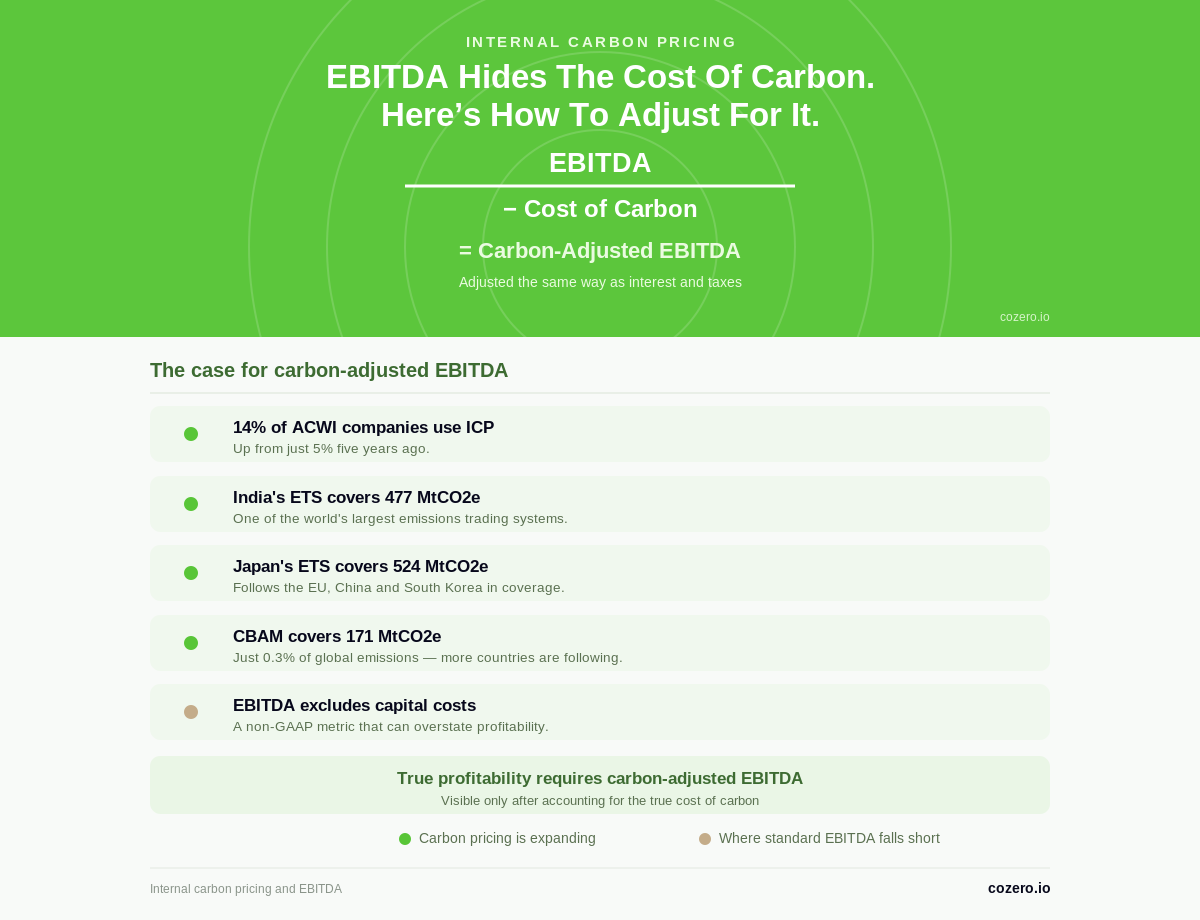
Internal Carbon Pricing: A Practical Path to Carbon-Adjusted EBITDA