

What happens when a sustainability team finally trusts its numbers
Key results

About MSQ
MSQ is a global marketing and technology services group of more than 10 creative, media, and technology agencies operating across the UK, Europe, North America, and Asia-Pacific. B Corp certified, with a global footprint and around 2,000 people, MSQ takes its sustainability commitments seriously.
One person. Ten agencies. One spreadsheet.
When Neil Clark joined MSQ as Chief Sustainability Officer, he inherited a carbon accounting process built on a single, sprawling spreadsheet, in a fast-growing group that was acquiring multiple businesses a year. Ten independent agencies across four continents, each with its own finance system, language, and category logic, were funnelling their data into a mapping exercise that was complex by design. For the FY21–25 re-baseline alone, that meant close to 100,000 rows to reconcile. By the time Neil had a number he could stand behind, it was twelve months out of date.
"Legacy carbon accounting leaves you working a year behind. By the time you see your footprint, the period it covers is long gone. For a business that actually wants to act on emissions, that lag isn't good enough." — Neil Clark, Chief Sustainability Officer, MSQ
What MSQ needed wasn't more headcount for reporting. It needed infrastructure, and a platform robust enough to build on.
Building on Cozero
Neil worked closely with Cozero, in particular Senior Customer Success Manager Anouchka Thiers and Customer Success Engineer Mathis Mira, to rebuild MSQ's entire emissions pipeline around a single organising principle: Cozero as the one source of truth. Cozero provides the foundation: industry best-practice emissions factors, methodology guidance, validation benchmarks, regulatory outputs, and a complete audit trail. On top of that, Neil built a bespoke automation layer via Cozero's API. It handles the upstream data chaos, reading utility bill PDFs, reconciling supplier names across 25 agencies and routing ambiguous finance transactions, before delivering clean, structured entries into Cozero.
The result is a pipeline that processed over 1,000 documents and 60,000+ finance rows in its first full year, with each entry traceable back to its source.

"The ease at which I can copy the Cozero API documentation and paste it into Claude is a real win. Here's the API definition, and working integration code in minutes." — Neil Clark, MSQ
The automation choices were deliberate down to the model level. Neil uses Claude Haiku, a lightweight AI model, for OCR tasks, with the software hosted on renewable-powered infrastructure via Root & Branch. "Why ask the most powerful model to just read a utility bill?" he says. Even the environmental footprint of the automation layer itself is tracked.
The Results
At a glance
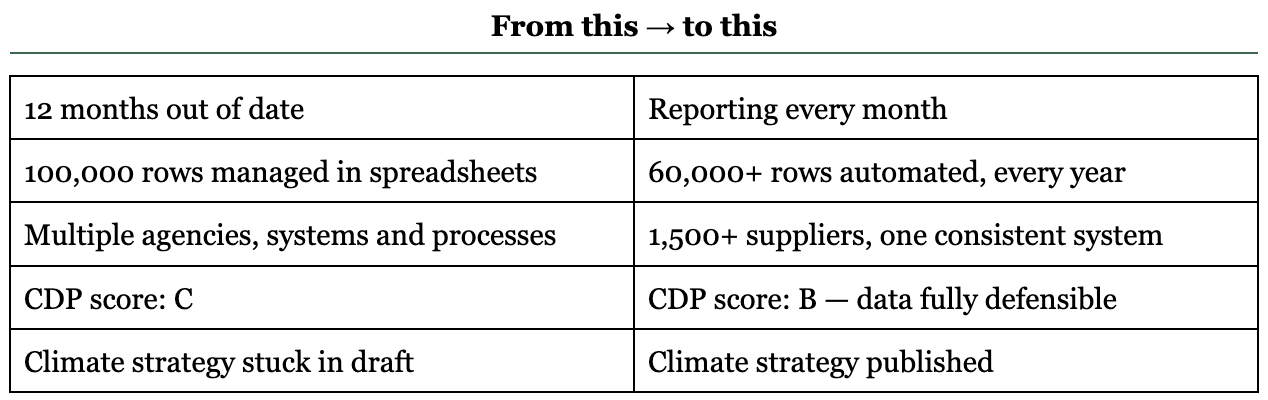
CDP moved from a C to a B rating in a single cycle. This wasn't just because the numbers improved. Neil could now narrate them with the precision that Cozero's audit trail and industry-standard emissions factors provide.
EcoVadis followed: MSQ jumped from Committed (50/100) to Bronze (64/100), with the environmental section scoring 76/100. ISO 14001 certification is targeted by end of 2026, with Cozero's audit trail and hotspot identification doing the heavy lifting.
"It's mainly based off the fact that I can really clearly describe exactly what we've done, what emissions factors we've used, because they're all industry best practice, because it's all in Cozero." — Neil Clark, Chief Sustainability Officer, MSQ
The data quality opened doors elsewhere too. Neil has been involved in 20 RFPs this year where supplying verified emissions data was a requirement. Without a structured, auditable system behind him, those engagements simply wouldn't have been possible. MSQ's elevated climate action strategy, two years in the making, is now live on the company website. And for the first time, Neil felt confident enough to purchase Energy Attribution Certificates that bring MSQ's market-based Scope 1 and 2 emissions to zero.
"I didn't have enough confidence in the numbers to previously make those purchases. But now I have. Because I know that what we've done is really good." — Neil Clark, Chief Sustainability Officer, MSQ
From reporting to acting
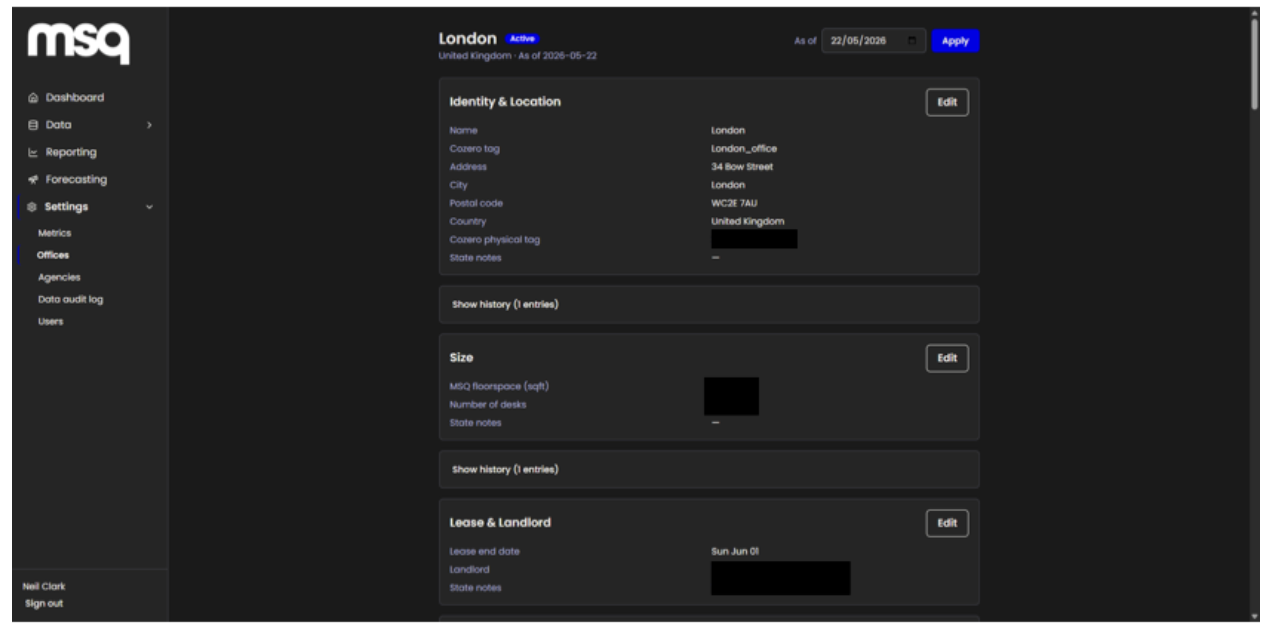
The bigger shift isn't any single metric: it's the move from annual reporting to a live, actionable system. With Cozero as a continuously updated source of truth, MSQ is transitioning to monthly and quarterly cadences, with consumption-based data replacing spend-based emissions factors category by category.
Singapore shows exactly what changes when the data improves. An earlier baseline flagged it as a flight-emissions hotspot. But once the data was structured in Cozero, the cause was visible: a high spend-based emissions factor in this region, not actual flight behaviour. An interesting finding, with a clear next step to acquire consumption-based data to back it up.
"Once I have the consumption-based data, I can say: actually, we are flying too much on this route, or this route could be replaced by a train. That's a real conversation." — Neil Clark, Chief Sustainability Officer, MSQ
What this approach demonstrated
Good carbon data infrastructure isn't just a reporting asset. A single system of record eliminates the drift that makes sustainability claims impossible to defend and frees the team to focus on strategy, not spreadsheet maintenance.
Consumption-based data is not a refinement. It is the difference between a finding and an intervention. Spend-based factors can be so overblown that they point to the wrong problems entirely. Without route-level flight data, there is no credible conversation to have with a regional team about reducing travel.
The same principle applies to the business case for automation itself. API-first platforms change what's possible for a lean sustainability function. MSQ's entire automation layer was built by one person, without a dedicated developer. The commercial return was immediate: 20 RFPs answered this year with verified emissions data. Without the infrastructure, that wouldn't have been possible.
MSQ's story makes a straightforward case for what good carbon data infrastructure actually unlocks. Better reporting scores, yes. But also the standing to make public commitments, answer commercial questions, and have harder conversations with the business, all backed by numbers that hold.
Put a business case behind every reduction measure.
Talk to our team about building a costed transition plan and a forecast that prices in carbon risk.
