CDP Reporting 2026: How to Improve Your CDP Score Before the September Deadline
Die meisten CDP-Punkte gehen durch schwache Prozesse verloren, nicht durch verpasste Fragen. Ein praktischer 3-Schritte-Leitfaden vor der September-Frist.

Get instant access
Link
How CDP Scoring Works
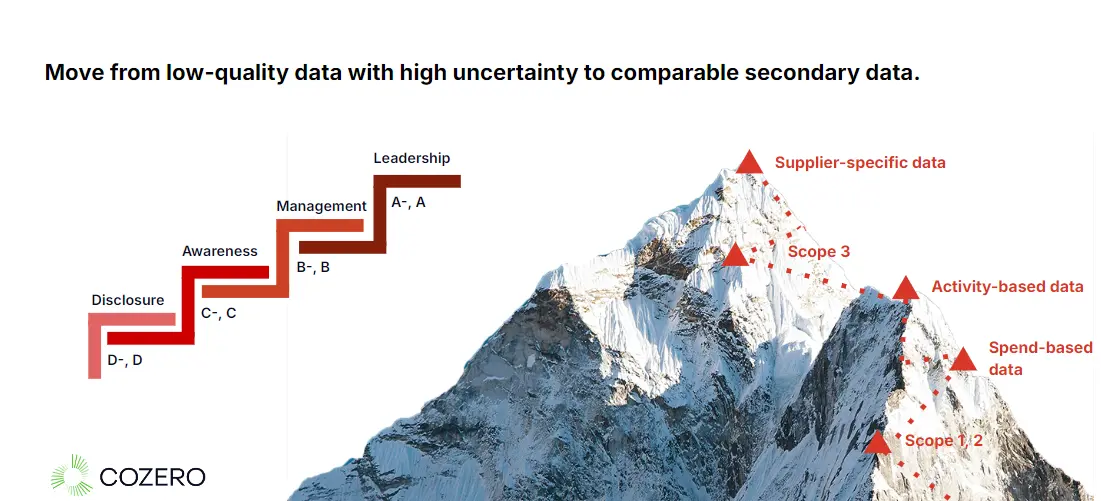
CDP scoring evaluates both disclosure quality and the maturity of climate management. Companies are assessed across progressive levels:
Disclosure → Awareness → Management → Leadership
In practice:
- Early levels reward completeness, transparency, and clear methodological boundaries
- Higher levels reward evidence of management systems, decision making, and credible action
- Leadership level expectations typically include stronger value chain work and a credible transition approach
One important nuance: wording does matter, but only when it reflects real processes and evidence. Strong writing cannot compensate for weak methodology. At the same time, unclear or inconsistent responses can still limit scoring even when the underlying work is solid.
The CDP Score Improvement Journey
Once Scope 1 and 2 foundations are in place, CDP progress typically happens in three practical leaps.
Leap 1: First Scope 3 assessment
Establish a defensible first view of Scope 3 categories, methods, and assumptions that can withstand internal scrutiny.
Leap 2: Detailed Scope 3 assessment
Improve data quality, category coverage, supplier engagement, and documentation so the submission becomes repeatable and credible year over year.
Leap 3: Transition planning
Connect targets to a robust reduction plan with clear actions, governance, and progress tracking that reads as implementation, not aspiration.
CDP Reporting 2026 Timeline
CDP publishes the exact annual timeline each cycle, and dates can shift slightly year to year. In most years, the pattern looks like this:
- Spring: Questionnaire and guidance published
- Early summer: Response window opens
- September: Scoring deadline for submissions
Operationally, this means companies that want a strong submission usually have data collection, validation, and internal review well underway before late summer.
Why Scope 3 Often Decides the Outcome
For many companies, Scope 3 represents the majority of total emissions and is also the hardest area to evidence robustly.
CDP reviewers typically look for clarity on:
- Which categories are included and why
- What methods and data sources were used
- How emission factors were selected and documented
- How data quality is assessed and improved over time
- Whether supplier engagement is structured and traceable
- Whether year over year changes are explained consistently
A common failure mode is having a Scope 3 number without a defensible methodology and evidence trail. That is often where scoring progress stalls.
The Second Game Changer: Transition Planning
Beyond Scope 3, a robust reduction strategy or transition plan is often what differentiates more mature submissions.
A credible transition plan narrative usually connects:
- Targets and their coverage
- The concrete levers that will reduce emissions, including indicative CO2 reduction potential and expected financial impact where possible
- Clear internal ownership and governance
- How progress is tracked year over year
- How the plan is updated as assumptions change
The plan does not need to be perfect. It needs to be structured, owned, and decision ready.
CDP and CSRD Alignment
For many European companies, CDP work increasingly overlaps with CSRD climate disclosure requirements, especially across ESRS E1 areas such as emissions, governance, risks, targets, and transition planning.
Rather than building parallel reporting tracks, many organizations are moving toward a single carbon data backbone that supports:
- CDP disclosure
- CSRD climate reporting
- Investor and customer requests
- Internal steering and decarbonization planning
The upside is straightforward: less duplication of work and fewer inconsistencies across frameworks.
How Cozero Supports CDP Reporting
Structured Scope 1 to 3 calculations
Cozero centralizes activity data and calculates Scope 1, 2, and 3 emissions using consistent boundaries, methodologies, and version control so results remain reproducible year over year.
Scope 3 methodology management
Cozero helps teams build a category-level Scope 3 inventory with fully documented methods, assumptions, data sources, and quality grading. Instead of treating Scope 3 as a one-off calculation, teams get a structured, repeatable methodology that stands up to internal review and external scrutiny.
Our calculation engine connects activity data, emission factor selection, and methodology documentation in one workflow. Emission factors are mapped with full traceability, so teams can clearly explain what factors were used, why they were selected, and how they relate to the underlying activity data.
The result is a defensible Scope 3 foundation that is consistent across reporting cycles and aligned with CDP expectations.
Audit ready documentation workflows
Because CDP readiness is often a documentation challenge, Cozero maintains a structured evidence trail across methods, sources, assumptions, and approvals, helping teams support their narrative with traceable inputs.
Built for CDP reporting outputs (SHARE module)
In Cozero’s SHARE module, teams can generate a CDP report that exports the CO2 data required for the CDP questionnaire, including supporting documentation. This helps teams pull the emissions and evidence pack in a structured way without rebuilding spreadsheets each cycle.
Important: this export supports the emissions and documentation parts of CDP, but it is not equivalent to completing the full CDP questionnaire, which covers a wider range of topics such as governance, risks, targets, and transition planning narrative.
Expert guidance alongside the platform
Beyond software, Cozero’s climate experts support teams in structuring Scope 3 assessments and shaping transition planning narratives so submissions are coherent, defensible, and aligned with CDP expectations.
Ready to Reduce Last Minute CDP Stress?
If CDP work tends to spike late in the cycle, the fastest wins usually come from getting two things under control early:
- A defensible Scope 3 approach with a clean evidence trail
- A transition plan narrative that clearly connects targets to delivery

Related articles
Connecting Carbon Emissions and Financial Statements using IFRS Accounting Standards
Internal Carbon Pricing: A Practical Path to Carbon-Adjusted EBITDA