Marginal Abatement Cost as a Strategic Decision-making Tool
Die Wahl der richtigen Dekarbonisierungshebel ist zentral für die Klimatransition. So hilft die Marginal-Abatement-Cost-Analyse (MAC) bei der Entscheidung.

Get instant access
Link
What are marginal abatement costs?
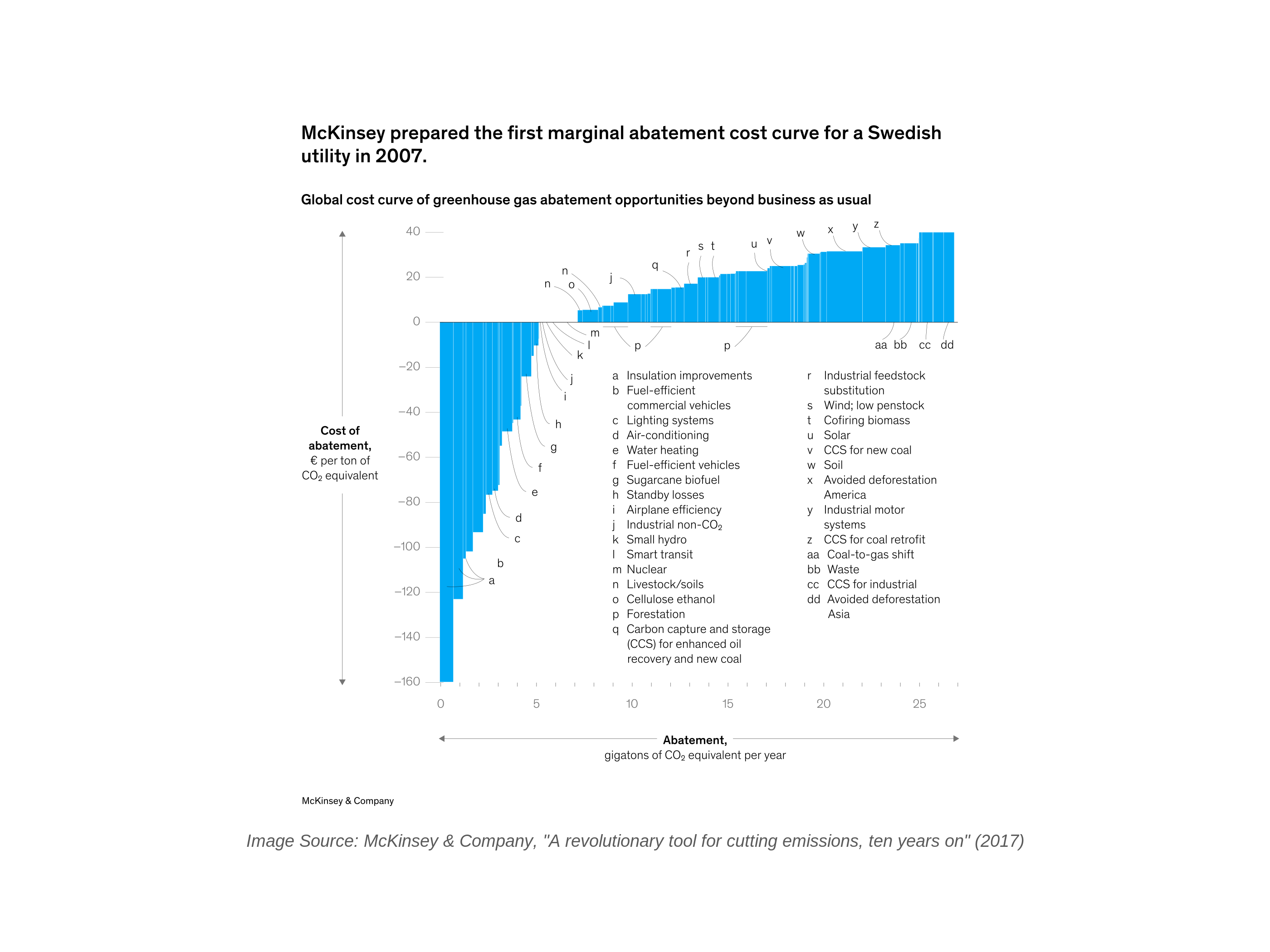
As companies work toward climate targets, they want to identify emissions reduction or “abatement” opportunities with the lowest cost and greatest impact. Marginal abatement cost (MAC) measures the cost of reducing one additional tonne of CO2e, averaged over a defined period. This gives companies a single figure for each abatement approach against a standard business-as-usual baseline.
MAC values can be negative or positive, indicating savings or added cost. This lets companies rank options and decide what to fund now, later, or not at all. While cost and carbon impact aren't the only factors that matter, MAC is a useful screening tool for abatement approaches.
When all available options for a company or sector are ranked this way, the result is called a marginal abatement cost curve (MACC). One of the earliest influential examples was McKinsey's 2007 analysis for a Swedish utility, which evaluated 30 abatement approaches. Today, McKinsey's MACC modelling has grown to cover 1,400 abatement measures across industries, value chains, and hundreds of thousands of carbon emissions factors.
MAC is dynamic, not fixed
Cost and impact estimates change over time. McKinsey has found that some approaches evaluated in 2007 scaled quickly and became far cheaper, while others stayed low-impact and expensive. A key differentiator is technological complexity: EVs, heat pumps, solar PV, and wind scaled fast thanks to simpler systems, modular design, and standardized manufacturing. In contrast, technologies like carbon capture (CCUS), nuclear, and green hydrogen have underperformed early projections. Initial CCUS estimates predicted the technology could reduce 3 gigatons by 2030, roughly 30 times more abatement than current estimates suggest is achievable in that time.
Adoption scale and cost decline also vary by region and sector, driven by regulations, raw material availability, and supply chain networks, among other factors. Sector-specific carbon pricing schemes add further variation. Goldman Sachs, which tracks a cost curve of 100 at-scale decarbonisation solutions, found the average abatement cost for lower-cost solutions fell 7% between 2024 and 2025.
Because of this variability, MAC should be one factor among several. Companies may also consider stakeholder priorities, trade-offs, whether abatement approaches lock in emissions, and how well a solution's timeline fits the broader business strategy.
MAC vs. Total Abatement Cost (TAC)
MAC works well for identifying low-cost, incremental changes, but reaching net zero often requires more transformative, capital-intensive shifts to achieve deep emissions cuts. This is where total abatement cost (TAC) comes in: it evaluates the cost of eliminating an organisation's entire remaining carbon footprint, not just a marginal or fractional portion of those emissions. The approach also ranks strategies relative to one another for a full transition. Used together, MAC and TAC help companies identify the lowest-cost, most practical path to net zero, considering both current low-cost strategies and transformative approaches.
Spotlight: Transportation
Transportation accounts for roughly 37% of global emissions and 25% of Europe's emissions, with road transport and passenger vehicles responsible for 71% of Europe's transport emissions. Global passenger transport demand is expected to triple by 2050.
According to the Net Zero by 2050 Roadmap, oil products supplied 90% of transport fuel needs in 2020, dropping below 75% by 2030 and to just over 10% by 2050. Electricity becomes the dominant fuel source by the 2040s; by 2050, the fuel mix shifts to roughly 45% electricity, 28% hydrogen, and 16% biofuels. Beyond switching fuel sources, other levers include route optimisation, modal shifts, and vehicle lightweighting.
Sector-specific challenges:
Passenger vehicles: Goldman Sachs found that the marginal abatement cost curve of transportation dropped in 2025 due to EV battery advancements and cost reduction. The analysis shows the cost of EV batteries could nearly halve from 2022 by the end of 2026, dropping from nearly $150 per kilowatt-hour (kWh) to $80 per kWh. This would mean the battery powered passengers would cost the same as cars with internal combustion engines (ICE) without subsidies in the U.S. The challenge is greater for adoption of EV trucks and buses, since batteries are still significantly more expensive than diesel fuel.
Shipping: Early movers often pay higher costs with limited options available on the market. A good example of this is low-carbon shipping, which requires more than a technological shift, because personnel will need training and additional infrastructure may need to be developed for full adoption. In this sense, electric fleets often start as smaller pilot projects that can be researched prior to more widespread adoption. In the case of sustainable fuels, transportation companies need to ensure a steady supply of the fuel before they invest in vehicles with engines that can operate using the fuel.
Aviation: Many long-range transportation modes including aviation have high energy and long-range requirements that exceed the current capabilities of electric battery powered engines. Sustainable fuels that could support these applications are still undergoing research and development prior to scaling and becoming available at airports. Uncertainties about how and when new low-emissions technologies will be adopted lead many companies to hesitate to adopt solutions that could disrupt commercial activities.
Last-mile delivery: For last mile solutions, transportation and logistics companies are subject to high consumer pressure for rapid delivery, creating a competitive drive for the shortest delivery times. Fast paced delivery expectations limit the tolerance a company may have for solutions that may not achieve the same performance levels as existing options. Companies need to carefully consider how their various business expectations stack in comparison to their need to decarbonise and closely monitor decarbonisation risks as they evolve.
Despite these challenges, current viable decarbonisation levers exist for the sector. Logistics emissions could be reduced by approximately 40-50 percent using technology available today according to McKinsey's analysis.
Calculating MAC using Cozero
Marginal abatement cost analysis offers valuable insight for decision-making in transportation and beyond. The Cozero platform helps companies estimate the cost of decarbonisation levers using MAC estimates and scenario planning for the technologies they're evaluating.
Speak to our experts to learn more.
Related articles