EU Ecodesign for Sustainable Products Regulation (ESPR): What It Means for Your Business and How the Digital Product Passport (DPP) Enables Compliance
Was die EU-Ökodesign-Verordnung (ESPR) für Ihr Unternehmen bedeutet, und wie der Digitale Produktpass (DPP) die Einhaltung der Vorschriften ermöglicht.

Get instant access
Link
The EU is entering a new phase of product sustainability regulation. The Ecodesign for Sustainable Products Regulation (ESPR), which entered into force on 18 July 2024, is the cornerstone of the European Commission’s approach to making products placed on the EU market more environmentally sustainable and circular.
Products and the way they are designed, produced, and used have a significant impact on the environment. Consumption in the EU is a major driver of climate change, pollution, and resource use. As part of the 2020 Circular Economy Action Plan, the ESPR aims to address these impacts by embedding sustainability requirements into product design, where most environmental impacts are determined. The regulation is expected to support the EU’s climate and environmental objectives, help double the circularity rate of material use, and contribute to energy efficiency targets by 2030.
For companies, this marks a structural shift. Sustainability is moving from a voluntary signal to a progressively standardized and data-driven requirement, rolled out through product-specific rules over time. This article breaks down what the ESPR regulation is, the key ESPR compliance requirements, and how the Digital Product Passport (DPP)—already live in Cozero—helps companies prepare in a practical, scalable way.
What is the ESPR regulation?
The Ecodesign for Sustainable Products Regulation (ESPR) is a cornerstone of the EU Green Deal and the Circular Economy Action Plan. It extends ecodesign rules beyond energy-related products to almost all physical goods sold in the EU.
Its objective is to make products more durable, repairable, recyclable, and transparent, while reducing their environmental and climate impact across the entire lifecycle.
At the heart of the ESPR is a simple principle: better decisions require better product sustainability data while ensuring that data must be accessible, comparable, and verifiable.
ESPR compliance requirements: from reporting to data infrastructure
While delegated acts will define product-specific rules over time, the direction is already set. Companies should expect to provide standardized information on topics such as:
- Product carbon footprint (PCF) and other environmental impacts
- Materials, sourcing, and substances of concern
- Repairability, recyclability, and durability indicators
- Compliance with circularity and sustainability criteria
Crucially, this information will no longer live in static PDFs or one-off reports. Under the ESPR, it must be machine-readable, up to date, and easily shareable across value chains.
This is where the Digital Product Passport (DPP) becomes essential.
Digital Product Passport and ESPR: a mandatory bridge
The digital product passport under the ESPR is designed as a standardized container for product sustainability data. It allows regulators, customers, and supply chain partners to access consistent information through a digital interface—often via a QR code or structured data format.
In practice, the DPP turns ESPR from a reporting obligation into a data infrastructure challenge. Companies must ensure that their product-level data:
- Is verified and traceable
- Can move seamlessly across systems and organizations
- Remains accessible as products and data evolve
Without the right tooling, this quickly becomes complex and manual.
From ESPR to DPP to product carbon data
One of the most critical building blocks of ESPR compliance is product carbon data. But carbon data only creates value when it can move easily.
That’s why Cozero’s approach follows a clear data flow:
ESPR → Digital Product Passport → Product Carbon Data → Cozero’s Platform
Cozero focuses on making verified PCF data usable, not just calculated. The Digital Product Passport feature ensures that once carbon data exists, it can be shared without friction throughout internal teams, with partners, or externally.
Cozero’s Digital Product Passport: built for real-world compliance
The Cozero DPP is now live for all customers. It transforms verified product carbon footprint data into a format that works across the supply chain.
With one click, teams can:
- Generate a Digital Product Passport directly from a product profile
- Review and validate the information before sharing
- Distribute the DPP via a QR code, a public link, or a JSON-LD file for automated exchange
The link remains stable—even as product data changes or the DPP is activated or deactivated—removing the need for repeated formatting and manual reporting.
By aligning with the UN Transparency Protocol, Cozero’s DPP supports credibility and comparability, w3hile staying flexible enough for evolving ESPR requirements.
How to prepare for ESPR compliance, starting now
Although ESPR obligations will roll out progressively, preparation cannot wait. Companies that start early gain a clear advantage by:
- Structuring product sustainability data at the source
- Ensuring product carbon footprints are verified and auditable
- Implementing systems that support digital product passport compliance
The ESPR is not just another regulation—it’s also a signal for a future where product transparency is the default. Digital product passports will be the interface through which sustainability is understood and exchanged.
Cozero’s DPP is an early step toward that interoperable ecosystem where emissions data flows naturally, trust in numbers increases, and compliance becomes a byproduct of good data management, not an administrative burden.
Want to see how Digital Product Passports work in practice? Explore Cozero’s platform and start preparing for ESPR compliance today.

Related articles
Connecting Carbon Emissions and Financial Statements using IFRS Accounting Standards
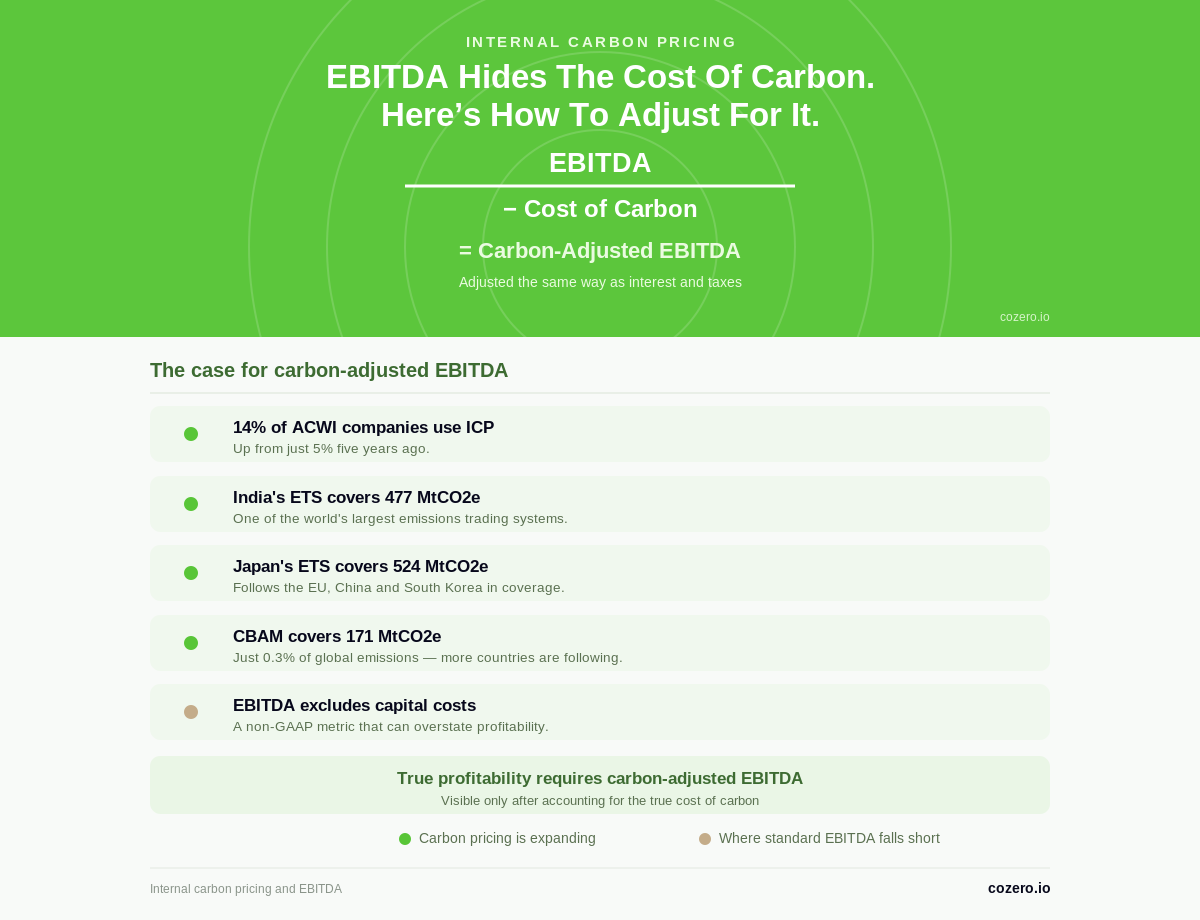
Internal Carbon Pricing: A Practical Path to Carbon-Adjusted EBITDA